


Epithalon – 50mg
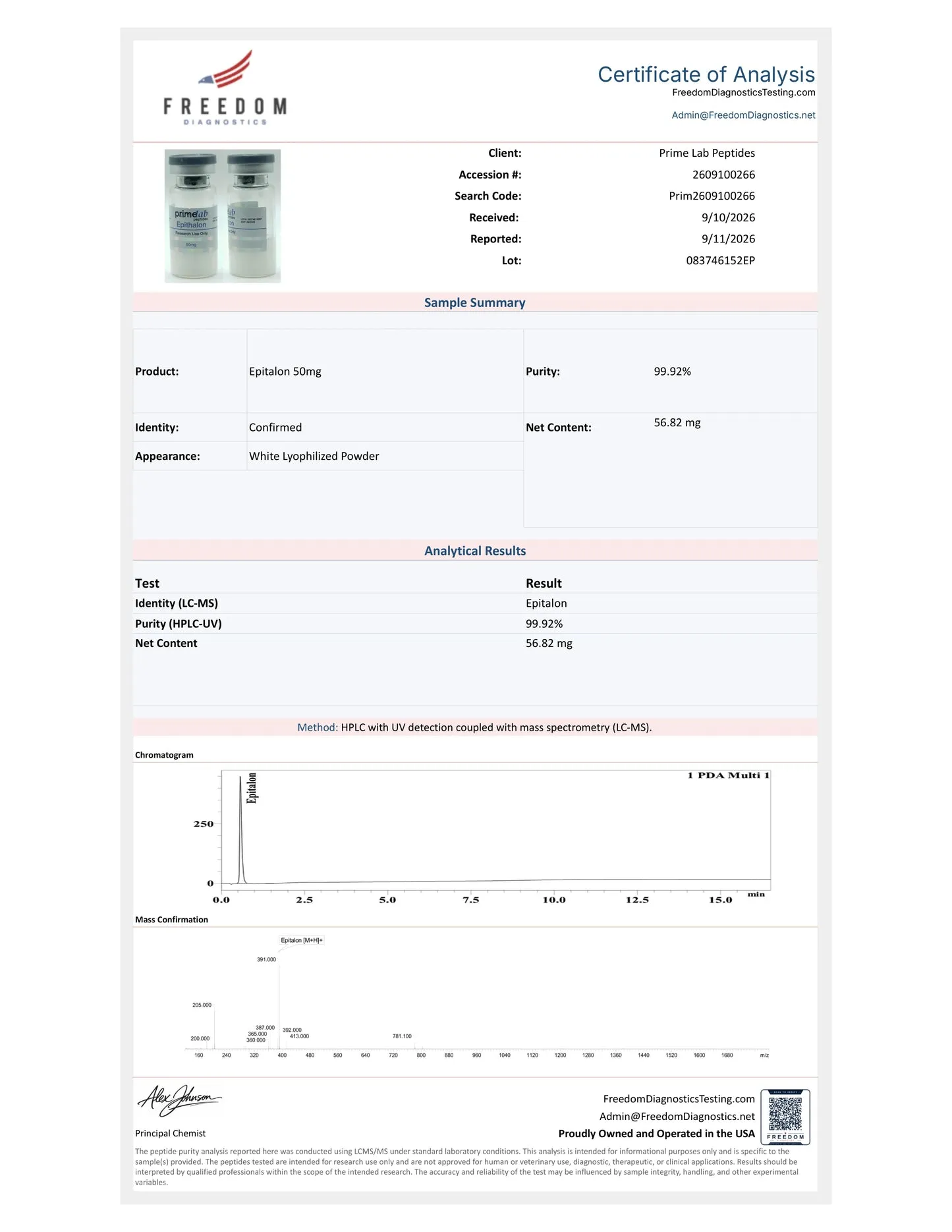
Certificates of Analysis
Epithalon, also known as Epitalon or by its sequence designation AEDG (Ala-Glu-Asp-Gly), is a synthetic tetrapeptide modeled on epithalamin, a pineal preparation. Its entire structure is four amino acids, and the research literature built on it is correspondingly narrow in scope.
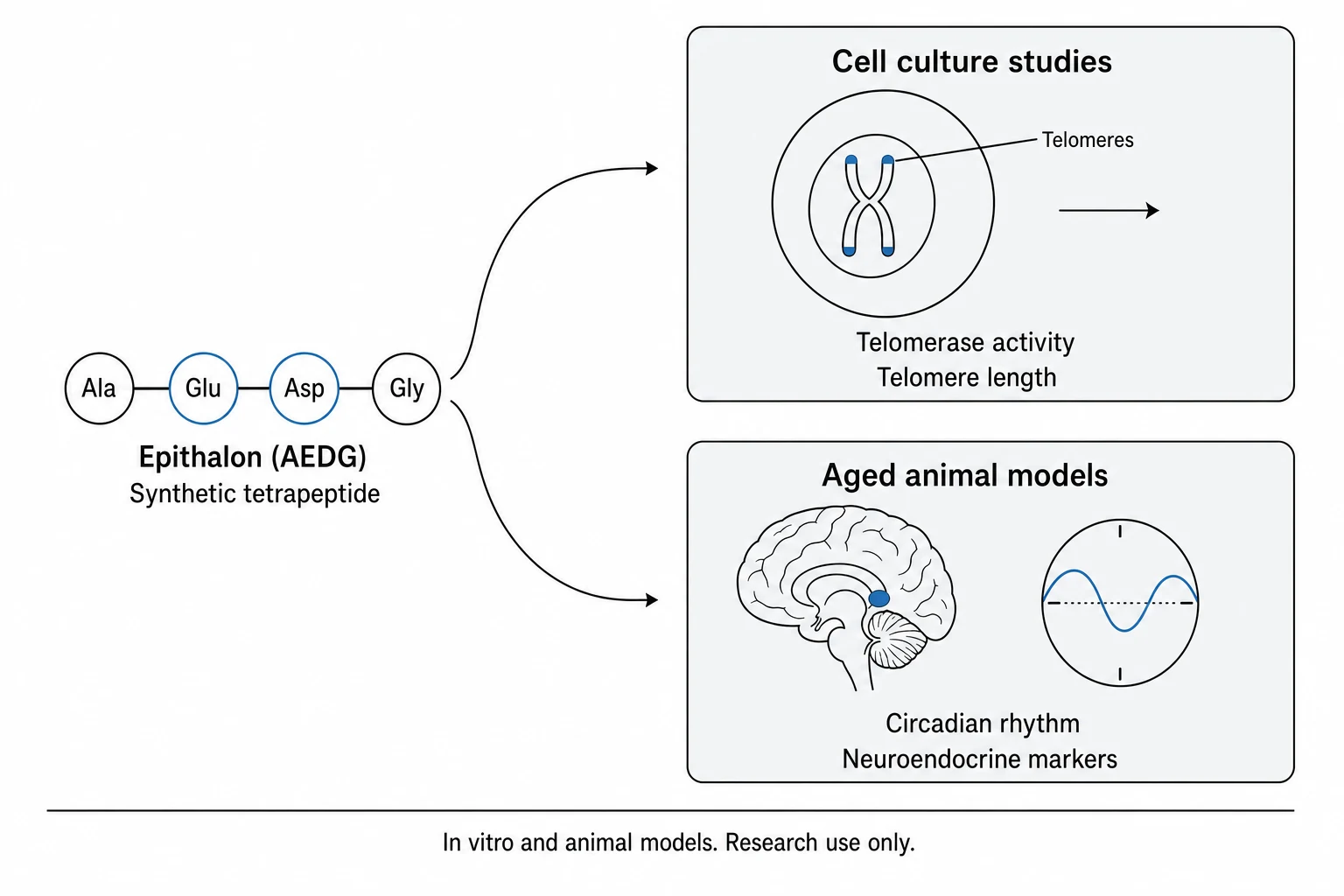
That literature concentrates in two areas. In human somatic cell culture, research groups report telomerase activation accompanied by telomere elongation, with related work extending the telomerase question into reproductive cell maturation models. In parallel, studies in aged animal models have examined pineal and circadian rhythm regulation together with neuroendocrine function. The two arms use different assays and different experimental systems, and a result obtained in one does not validate the other.
Researchers should weigh this evidence carefully. Work on Epithalon is dominated by a small number of research groups and sits within experimental gerontology; independent replication is limited, and no receptor, signaling pathway, or epigenetic mechanism is established in the available reports. Findings obtained in vitro or in animal models do not establish what occurs in an intact human organism, and no clinical conclusion follows from a change measured in culture.
This product is supplied for laboratory research use only. It is not a drug, food, or cosmetic, and it is not intended for human or veterinary use, diagnosis, treatment, or any other application outside a controlled research setting.
Couldn't load pickup availability
Need reconstitution solution? Don’t forget to add Bacteriostatic Water before checkout.

Synthetic AEDG Tetrapeptide
The Four-Amino-Acid Sequence Modeled on the Pineal Preparation Epithalamin
Epithalon, also written Epitalon and designated AEDG after its Ala-Glu-Asp-Gly sequence, is a synthetic tetrapeptide modeled on the pineal preparation epithalamin. The molecule is four amino acids long, and the published literature built on it stays close to that single sequence.
Published work on Epithalon falls into two settings. In human somatic cell culture, investigators have measured telomerase activity and telomere length. In aged animal models, they have recorded circadian and neuroendocrine endpoints. Both lines of investigation sit within experimental gerontology rather than clinical medicine, and each reported finding belongs to the model in which it was obtained.
Telomerase Activation & Telomere Length
What Cell-Culture Studies Report About Epithalon and Telomere Dynamics
Published work reports telomerase activation in human somatic cell culture exposed to Epithalon, together with telomere elongation in those same culture systems. These are measurements taken in cells, and the reports describe an association between exposure and the measured endpoints. No receptor, signaling pathway, or epigenetic route is established in the available literature.
A related line of work extends the telomerase question into reproductive cell maturation models. All of it should be read as in vitro and animal-cell data. A change measured in culture does not describe what occurs in an intact organism, and no clinical endpoint follows from it.

Research Applications
From Circadian Rhythm Models to Experimental Gerontology Endpoints
Published work on Epithalon groups into a small number of experimental axes: telomerase activity and telomere length in cell culture, pineal and circadian rhythm regulation, neuroendocrine function in aged animal models, reproductive cell maturation models, and broader experimental gerontology endpoints. The circadian and neuroendocrine observations come from aged animal models, and they are reported for those cohorts and species only.
The two arms of this field use different assays and different experimental systems, so a result obtained in one does not validate the other. Investigators evaluating Epithalon need to know which arm a given report belongs to before placing weight on it.

The Science Behind AEDG: What the Epithalon Literature Reports, and What It Does Not
Epithalon is a synthetic tetrapeptide built on the Ala-Glu-Asp-Gly sequence and modeled on the pineal preparation epithalamin. What draws laboratory interest is one specific entry in the published record: that a four-residue peptide is associated with telomerase activation and telomere elongation in human somatic cell culture. That is an observation at the level of the cell, obtained in vitro.
A second and largely separate literature concerns whole-organism physiology in aged animals, where investigators have recorded effects on circadian and neuroendocrine rhythms. Those findings belong to the aged-animal models in which they were measured. They are not the same body of evidence as the culture work, and neither arm explains the other.
The honest reading of this field is that it remains narrow. The Epithalon literature is dominated by a small number of research groups and sits within experimental gerontology; independent replication is limited. No molecular mechanism is described in that literature: no receptor, no signaling pathway, no epigenetic route. The telomerase observation is therefore best treated as a hypothesis under active investigation rather than a settled mechanism, and researchers should design their controls accordingly rather than reading across from culture or animal endpoints to human physiology.
Scientific Literature
- Al-Dulaimi S, et al. Epitalon increases telomere length in human cell lines through telomerase upregulation or ALT activity. Biogerontology. 2025;26(5):178.
- Araj SK, et al. Overview of Epitalon-Highly Bioactive Pineal Tetrapeptide with Promising Properties. Int J Mol Sci. 2025;26(6):2691.
- Khavinson VKh, et al. Epithalon peptide induces telomerase activity and telomere elongation in human somatic cells. Bull Exp Biol Med. 2003;135(6):590-592.
- Ullah S, et al. Epitalon-activated telomerase enhance bovine oocyte maturation rate and post-thawed embryo development. Life Sci. 2025;362:123381.
- Goncharova ND, et al. Pineal peptides restore the age-related disturbances in hormonal functions of the pineal gland and the pancreas. Exp Gerontol. 2005;40(1-2):51-57.
Packaged with care, shipped fast.
We’re a passionate team obsessed with quality, not margins.
- Company
- Price
- Purity
- Quantity
- Shipping
-
TB-500 – 5mg
-
Prime
Lab PeptidesTypical
Competitor -
$45.00$80.00
- ≥99%97%
- 5mg5mg
- Free 2-Day Shipping3-10 Business Day
-


