


GLP-1SG – 10mg
Semaglutide is the most extensively studied GLP-1 receptor agonist — a single, highly selective incretin-pathway agonist that has become the reference standard against which newer dual and triple agonists are measured. It acts on appetite signaling, glucose-dependent insulin release and gastric emptying.
In the landmark 68-week STEP 1 obesity trial, participants on 2.4 mg recorded a mean body-weight reduction of 14.9%, versus 2.4% on placebo[1]. 50% lost 15% or more of their body weight, and 69% lost at least 10%[1].
Its evidence base runs deep: in type-2 diabetes (SUSTAIN 1) semaglutide cut HbA1c by 1.55 points[2], and in the 17,604-patient SELECT cardiovascular trial it reduced major cardiac events by 20% in adults with obesity and no diabetes[3].
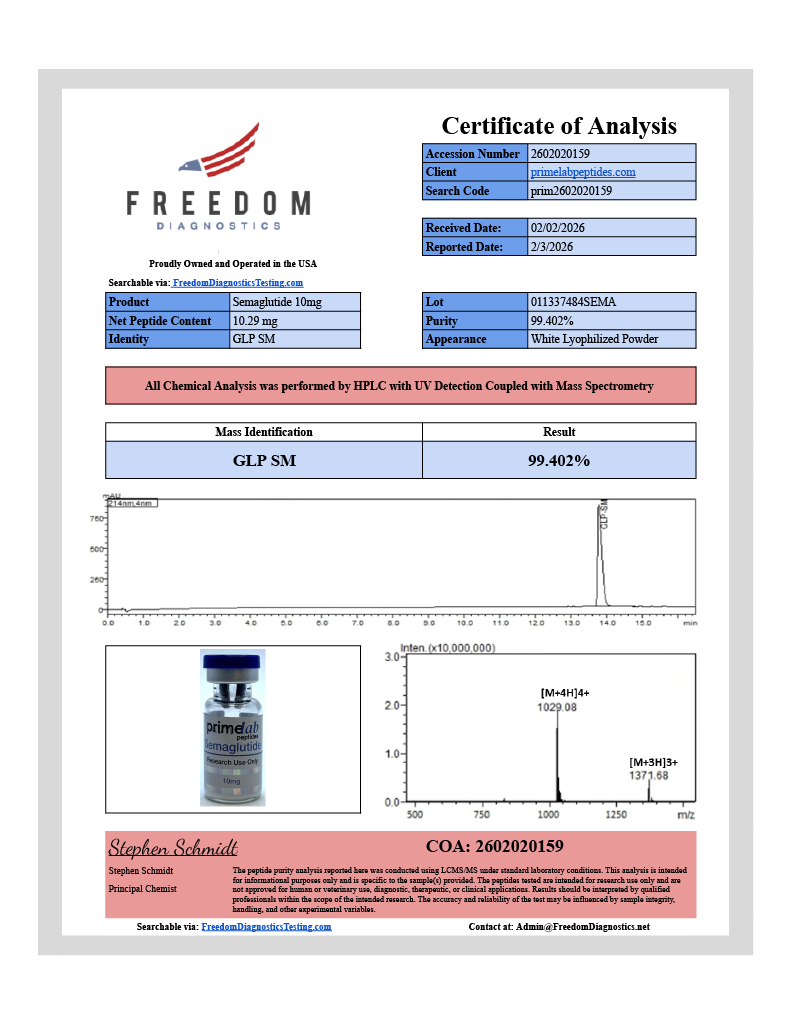
Supplied as a lyophilized powder for reconstitution. Figures above summarize published clinical findings on the semaglutide molecule and are provided as scientific reference for laboratory research only.
Couldn't load pickup availability
Need reconstitution solution? Don’t forget to add Bacteriostatic Water before checkout.
Running a longer study? Save with the 10-vial packSemaglutide – 10mg (10 Vials) — $585.00 ($58.50/vial) →
Reference Standard GLP-1 Agonist
The Most Studied GLP-1 Compound for Metabolic Research
Semaglutide is a GLP-1 receptor agonist with 94% sequence homology to native human GLP-1. Its extended half-life of approximately 7 days — achieved through albumin binding and DPP-4 resistance — makes it suitable for weekly research protocols. For scientists studying incretin signaling, glucose homeostasis, and metabolic pathway interactions, Semaglutide has become the reference standard in GLP-1 receptor research.
- 94% sequence homology to native human GLP-1
- Extended half-life (~7 days) suitable for weekly protocols
- Extensively characterized pharmacokinetic profile
- High stability for long-duration research designs
- Consistent, reproducible data across experimental models
Mechanism of Action
How Semaglutide Interacts with Metabolic Pathways
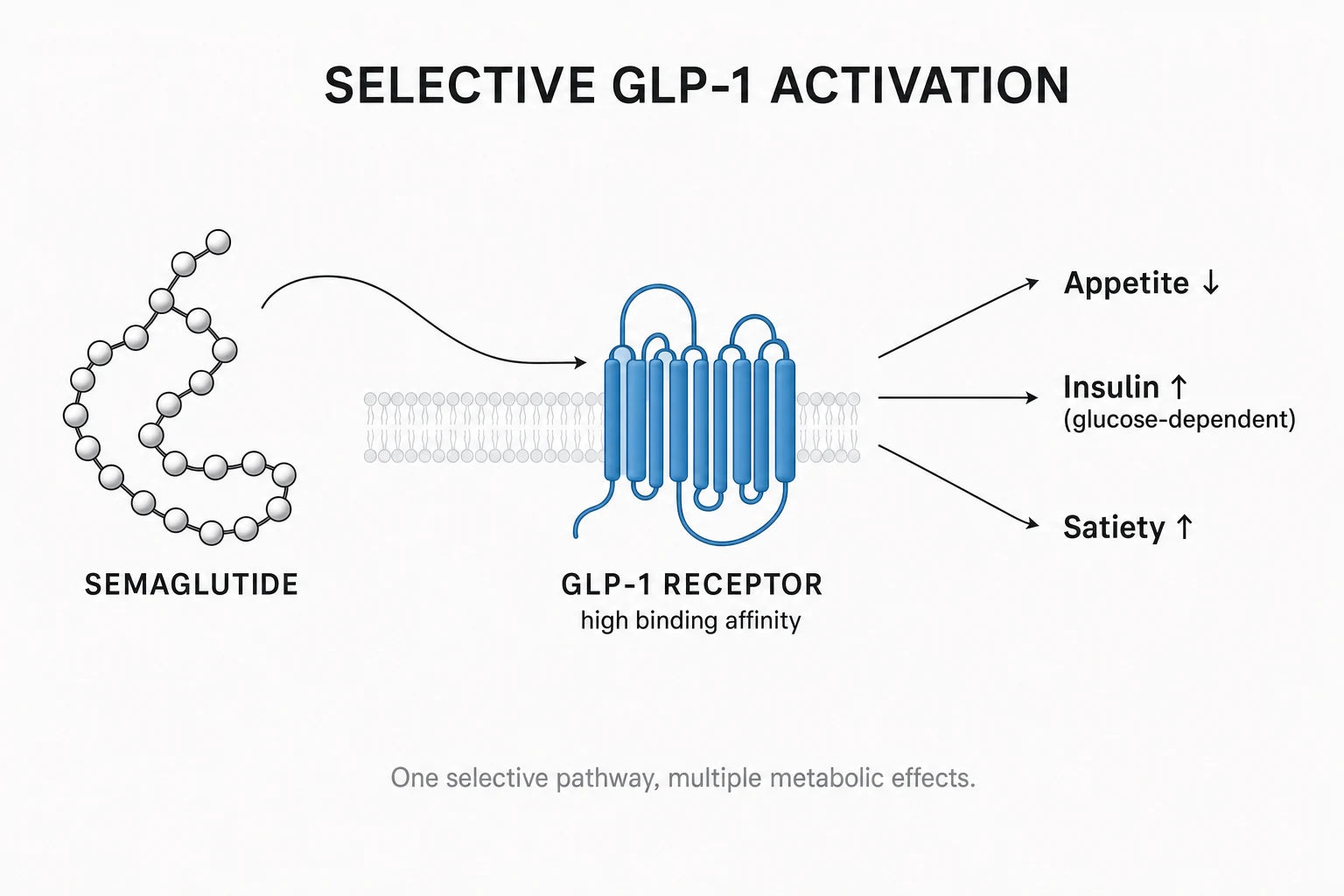
Semaglutide engages multiple signaling pathways through GLP-1 receptor activation. Published research documents its interaction with hypothalamic GLP-1 receptors involved in appetite-related signaling, enteric nervous system pathways that modulate gastric motility, and pancreatic beta-cell receptors involved in insulin secretion cascades. This multi-pathway engagement provides researchers with a comprehensive tool for studying incretin biology.
- Hypothalamic GLP-1 receptor binding and signaling studies
- Gastric motility pathway modulation research
- Pancreatic beta-cell receptor interaction studies
- Glucagon secretion pathway investigations
- Predictable pharmacokinetics for controlled experiments
Research Applications
From Receptor Binding to Pathway Analysis — Proven Research Utility
Semaglutide is the most extensively characterized GLP-1 agonist available for research. Its well-documented pharmacological profile makes it ideal for comparative studies, baseline establishment, and mechanistic investigations. Whether exploring incretin receptor pharmacology, insulin secretion pathways, or cardiovascular biomarker correlations, Semaglutide provides the reliable foundation for rigorous scientific investigation.
- GLP-1 receptor binding kinetics and affinity studies
- Glucose homeostasis pathway investigations
- Gastric motility and enteric signaling research
- Cardiovascular biomarker correlation studies
- Comparative baseline for dual/triple agonist research
- Extended half-life suitable for weekly research protocols

The Science Behind GLP-1 Research: Why Semaglutide Remains the Reference Standard
Semaglutide has established itself as the benchmark compound for GLP-1 receptor research. With 94% sequence homology to native human GLP-1 and an extensively documented pharmacokinetic profile, it provides researchers with the reliability and reproducibility essential for rigorous scientific investigation.
What distinguishes Semaglutide structurally? Its engineered resistance to DPP-4 degradation and strong albumin binding create an extended half-life of approximately 7 days — enabling convenient weekly research protocols while maintaining consistent receptor activation throughout the experimental period.
The compound's multi-pathway mechanism — engaging hypothalamic signaling, gastric motility modulation, pancreatic receptor interactions, and glucagon pathway regulation — makes it invaluable for comprehensive metabolic pathway studies. Researchers can investigate individual signaling cascades or explore how these systems interact under controlled conditions.
As newer dual and triple agonists emerge, Semaglutide serves a critical role as the reference standard for comparative research. Its well-characterized behavior provides the baseline against which next-generation compounds can be evaluated, making it essential for any laboratory studying incretin biology and GLP-1 receptor pharmacology.
For laboratory and in-vitro research use only. Not for human or animal use.
Scientific Literature
- Marso SP, et al. Semaglutide and Cardiovascular Outcomes in Patients with Type 2 Diabetes. N Engl J Med. 2016;375:1834-1844.
- Wilding JPH, et al. Once-Weekly Semaglutide in Adults with Overweight or Obesity (STEP 1). N Engl J Med. 2021;384:989-1002.
- Knudsen LB, Lau J. The Discovery and Development of Liraglutide and Semaglutide. Front Endocrinol. 2019;10:155.
- Sorli C, et al. Efficacy and safety of once-weekly semaglutide monotherapy versus placebo (SUSTAIN 1). Lancet Diabetes Endocrinol. 2017;5(4):251-260.
- Kommu S, Whitfield P. Semaglutide. StatPearls Publishing; 2024.
Packaged with care, shipped fast.
We’re a passionate team obsessed with quality, not margins.
- Company
- Price
- Purity
- Quantity
- Shipping
-
GLP-1SG – 10mg
-
Prime
Lab PeptidesTypical
Competitor -
$90.00$160.00
- ≥99%98%
- 10mg10mg
- Free 2-Day Shipping3-10 Business Day
-


