


Categories
Recent Articles
-
The Science Behind Glow Peptide Boosting Collagen and Restoring Skin's Natural Glow?
213 days ago
Glow peptides are gaining research attention for their ability to stimulate collagen synthesis and support...
-
What Evidence Supports GHK-Cu’s Therapeutic Potential in Oxidative Stress?
225 days ago
GHK-Cu is a copper-binding tripeptide that has been widely studied for its role in regulating...
-
Can Scientific Evaluation Uncover GLP-1 Signaling Mechanisms in Arterial Stiffness?
227 days ago
This blog explores the scientific evaluation of GLP-1 signaling and its mechanistic link to arterial...
All product descriptions and articles provided on this website are intended strictly for informational and educational purposes. Our products are designed exclusively for in-vitro research (i.e., experiments conducted outside of a living organism, typically in glassware such as test tubes or petri dishes). These compounds are not approved by the FDA for use in humans or animals. They are not medications, nor are they intended to diagnose, treat, prevent, or cure any disease or medical condition. Any bodily administration-human or animal-is strictly prohibited by law. Our products are not for human consumption under any circumstances.

The Science Behind Glow Peptide Boosting Collagen and Restoring Skin's Natural Glow?
Glow peptides are gaining research attention for their ability to stimulate collagen synthesis and support cellular regeneration. Moreover, studies show their molecular action enhances skin structure and elasticity. Additionally, researchers are investigating multi-peptide interactions to gain deeper insights into collagen regulation. Therefore, Prime Lab Peptide provides reliable, research-grade materials that advance precision and consistency in peptide-based scientific studies.

What Evidence Supports GHK-Cu’s Therapeutic Potential in Oxidative Stress?
GHK-Cu is a copper-binding tripeptide that has been widely studied for its role in regulating oxidative stress and providing antioxidant defense. This research-focused blog examines molecular pathways, cellular mechanisms, and clinical evidence that support its role in maintaining redox balance. Designed for researchers, it emphasizes neutral, evidence-based insights into GHK-Cu’s scientific potential without implying therapeutic or human-use claims.

Can Scientific Evaluation Uncover GLP-1 Signaling Mechanisms in Arterial Stiffness?
This blog explores the scientific evaluation of GLP-1 signaling and its mechanistic link to arterial stiffness regulation. It highlights how GLP-1 receptor agonists influence vascular tone, endothelial function, and inflammation. Designed specifically for researchers, it provides evidence-based insights supported by current studies. The article also emphasizes research-grade GLP-1 peptides from Prime Lab Peptides for experimental reliability.

What Current Scientific Evidence Says About Melanotan II Preventing Dermatologic Disease?
This research-based article examines the current scientific evidence on Melanotan II in dermatologic studies. It highlights MTII’s role in MC1R–PTEN signaling, oxidative stress regulation, and anti-melanoma cellular responses in controlled models. Moreover, it discusses emerging directions shaping peptide-driven dermatology research. Overall, the content emphasizes the importance of high-purity laboratory peptides to support reliable scientific progress.

What Evidence Supports GHK-Cu Peptide in Preventing COPD and Pulmonary Fibrosis?
GHK-Cu has gained significant attention in pulmonary research for its ability to modulate fibrosis, oxidative stress, and redox balance. Recent studies explore its molecular pathways, signaling mechanisms, and experimental validation. This evidence-driven review highlights the ongoing challenges, current findings, and reproducible methodologies that support the scientific relevance of GHK-Cu in COPD and pulmonary fibrosis investigations.
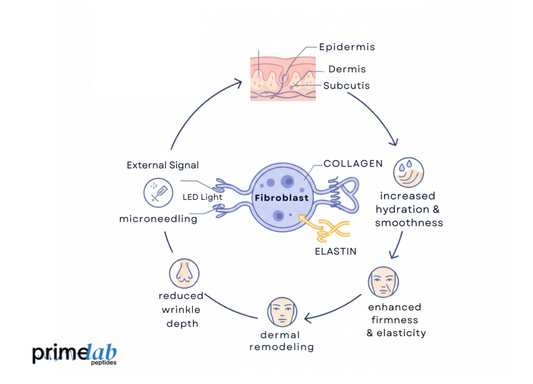
Does Glow Peptide Stimulate Fibroblast Activity to Enhance Dermal Elasticity?
Glow Peptide is advancing dermatological research by stimulating fibroblast activity and promoting collagen and elastin synthesis. Supported by university-led studies, it demonstrates measurable improvements in dermal elasticity, structure, and cellular regeneration. Through topical and injectable applications, Glow Peptide delivers consistent, reproducible results, providing researchers with a reliable foundation for peptide-based innovation in skin science.