
All product descriptions and articles provided on this website are intended strictly for informational and educational purposes. Our products are designed exclusively for in-vitro research (i.e., experiments conducted outside of a living organism, typically in glassware such as test tubes or petri dishes). These compounds are not approved by the FDA for use in humans or animals. They are not medications, nor are they intended to diagnose, treat, prevent, or cure any disease or medical condition. Any bodily administration-human or animal-is strictly prohibited by law. Our products are not for human consumption under any circumstances.

Short answer: GHK-Cu carries the collagen evidence in Glow. BPC-157 and TB-500 do not — and the 70 mg blend itself has never been tested as a unit.
Glow is one vial holding three peptides: GHK-Cu, BPC-157 and TB-500 (thymosin β4), supplied as 70 mg of lyophilized powder. Only GHK-Cu has controlled human work with collagen density and skin elasticity as measured endpoints — and that work was done with topical cosmetic formulations, not with an injected blend.
BPC-157 and TB-500 are repair and angiogenesis peptides. What their published studies actually measure is cell migration, new vessel formation and tendon or wound healing, overwhelmingly in animals and cell culture. Procollagen output in human dermis is not their endpoint, so treating all three as interchangeable collagen boosters is where most pages on this topic stop matching the literature.
That distinction matters for anyone reading a timeline: since no peer-reviewed study has tested the three peptides combined the way the vial is sold, everything said about the mixture is extrapolated from its parts, and the parts do not carry equal evidence. These compounds are supplied for research use only.
How Collagen Synthesis Works — and What Slows It Down
Collagen synthesis is governed by tightly regulated intracellular networks that coordinate transcriptional activation, growth factor signaling, and extracellular matrix assembly. Within dermal fibroblasts, procollagen chains are synthesized in the endoplasmic reticulum, undergo enzymatic post-translational modification, and are secreted for extracellular fibril formation. This multistep process requires synchronized regulation at genetic, metabolic, and structural levels.
Research published in Biomolecules emphasizes that collagen production depends not only on transcriptional activators but also on cellular redox equilibrium and signal integration across multiple pathways [2]. Disruption in oxidative balance or signaling precision can significantly impair collagen deposition and fibrillar organization within dermal tissue.
Primary regulatory systems include:
- Wnt/β-catenin signaling: Enhances fibroblast activation and promotes transcription of collagen-encoding genes through nuclear β-catenin stabilization.
- mTOR pathway: Facilitates translational efficiency and supports high-demand protein biosynthesis required for matrix production.
- Integrin-mediated mechanotransduction: Converts extracellular mechanical forces into intracellular signals that stimulate structural protein synthesis.
- HIF-1α modulation: Adjusts collagen expression in response to metabolic stress and oxygen availability within tissue microenvironments.
Under physiological conditions, these signaling networks operate in coordinated balance. However, aging, oxidative stress, and inflammatory burden disrupt this equilibrium, leading to diminished collagen density and weakened structural integrity. Targeted peptide stimulation is therefore designed to recalibrate these pathways and restore organized extracellular matrix biosynthesis in controlled experimental systems.
Which Peptide in Glow Actually Builds Collagen
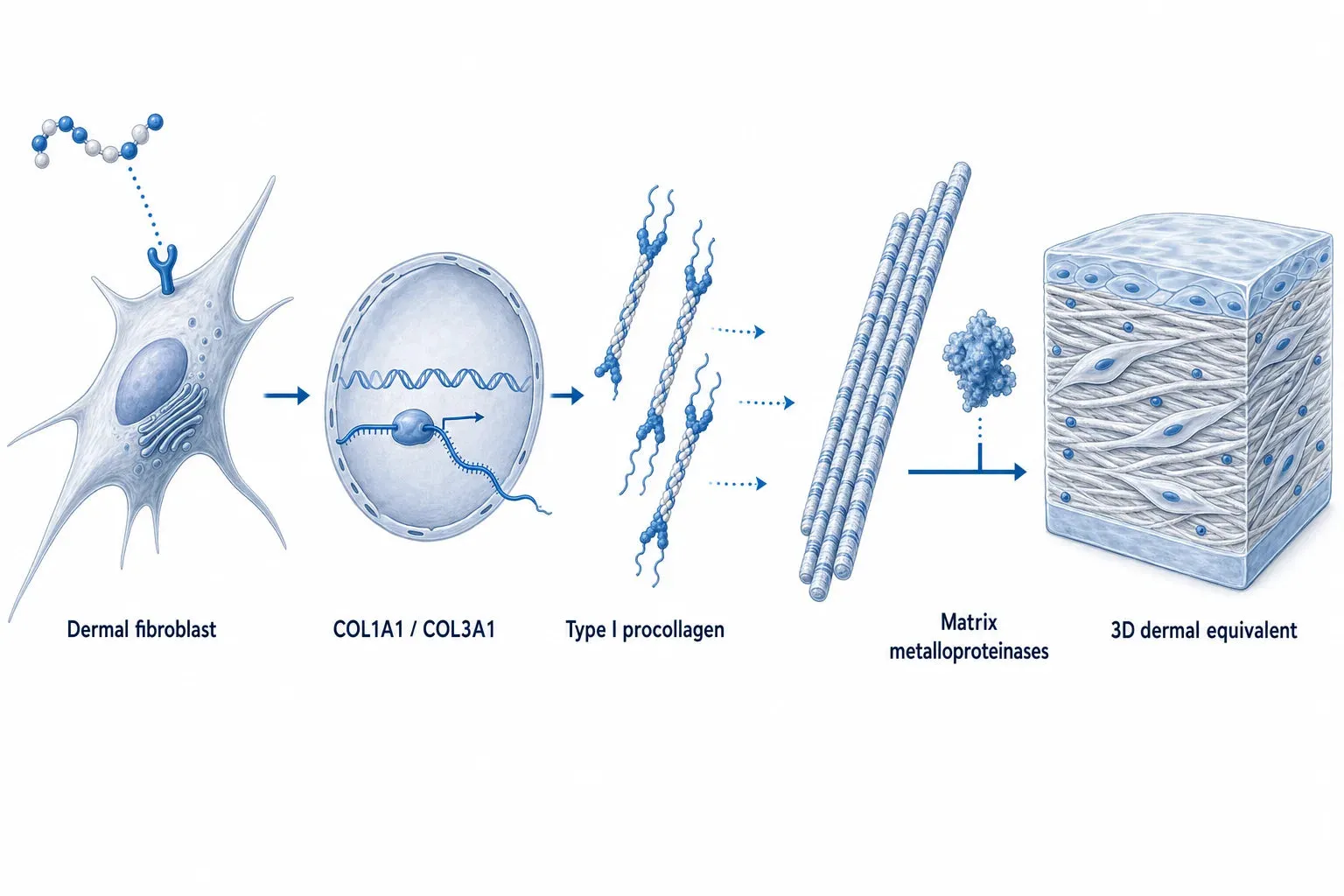
Building on these foundational regulatory mechanisms, experimental investigations have evaluated whether peptide-based stimulation can amplify collagen output in dermal fibroblasts. Controlled in vitro studies demonstrate that bioactive signal peptides and matrix-derived fragments significantly enhance procollagen gene transcription while concurrently modulating degradative enzyme activity.
Published findings indicate that specific peptide formulations increase type I procollagen mRNA levels and reduce collagen-degrading enzyme expression under laboratory conditions. These molecular shifts indicate a dual-action mechanism: stimulating biosynthesis while preserving newly formed structural proteins.
These genetic and enzymatic adjustments translate into measurable structural outcomes:
- Upregulated COL1A1 and COL3A1 transcription: Elevated gene expression promotes expanded fibrillar assembly and increased dermal density.
- Controlled matrix metalloproteinase activity: Balanced enzymatic regulation minimizes premature collagen breakdown and protects newly synthesized fibers.
- Enhanced fibroblast replication capacity: Increased cell proliferation sustains ongoing matrix production and structural reinforcement.
Three-dimensional dermal equivalent models further validate these findings, demonstrating thicker collagen bundles, improved fibril alignment, and greater matrix uniformity following peptide exposure. Collectively, these data support mechanistic validity at both molecular and architectural levels.
What the Collagen Evidence Covers — and What It Does Not
While structural enhancements are observable in tissue models, mechanistic clarity requires examination at the transcriptional interface. Experimental evidence indicates that the Glow Peptide Blend influences procollagen synthesis by enhancing the nuclear localization of transcription factors that activate collagen-encoding genes.
Research published in the International Journal of Molecular Sciences demonstrates that bioactive peptides modulate gene networks governing extracellular matrix assembly and tissue remodeling [3]. These peptides interact with intracellular signaling cascades that promote chromatin accessibility and increase transcription factor binding to collagen gene promoters.
Additional experimental data indicate that stimulated fibroblasts exhibit increased secretion of type I procollagen and improved organization of extracellular fibrils in vitro. Importantly, this response originates from coordinated genetic activation rather than passive structural accumulation, confirming that peptide-induced collagen enhancement is fundamentally driven at the genomic and signaling level within dermal fibroblasts.
Topical vs Injectable: How Long Before Collagen Changes Show
Beyond molecular activation, translational research has examined how delivery strategies influence collagen-focused outcomes. Experimental evidence supports the evaluation of Glow Peptide Blend in both topical and injectable systems due to its molecular diffusion properties and receptor-binding efficiency. Optimized formulations enhance dermal penetration and improve direct engagement with fibroblast populations.
The primary research frameworks include:
1. Topical Collagen Activation Models
Topical concentrations ranging from 0.01% to 1% are assessed for epidermal permeability, dermal diffusion, and transcriptional activation of collagen-related genes. Advanced encapsulation technologies enhance molecular stability and enable sustained fibroblast stimulation under controlled conditions.
2. Microneedling-Enhanced Delivery
Microneedling introduces transient microchannels that increase peptide bioavailability within deeper dermal compartments. This localized enhancement of exposure amplifies fibroblast responsiveness and accelerates matrix remodeling dynamics under standardized laboratory conditions.
3. Injectable Collagen Research Blends
Injectable formulations deliver peptides directly into collagen-producing dermal zones, enabling precise evaluation of dose-response relationships and the development of fibrillar architecture. These models allow quantitative assessment of collagen deposition patterns and structural reinforcement over defined experimental timelines.
Collectively, these approaches enable comprehensive measurement of transcriptional activation, changes in matrix density, fibril organization, and long-term extracellular stability. Such standardized frameworks ensure reproducibility and strengthen the translational relevance of collagen-focused peptide research.
Sourcing Glow for Collagen Work: What to Verify
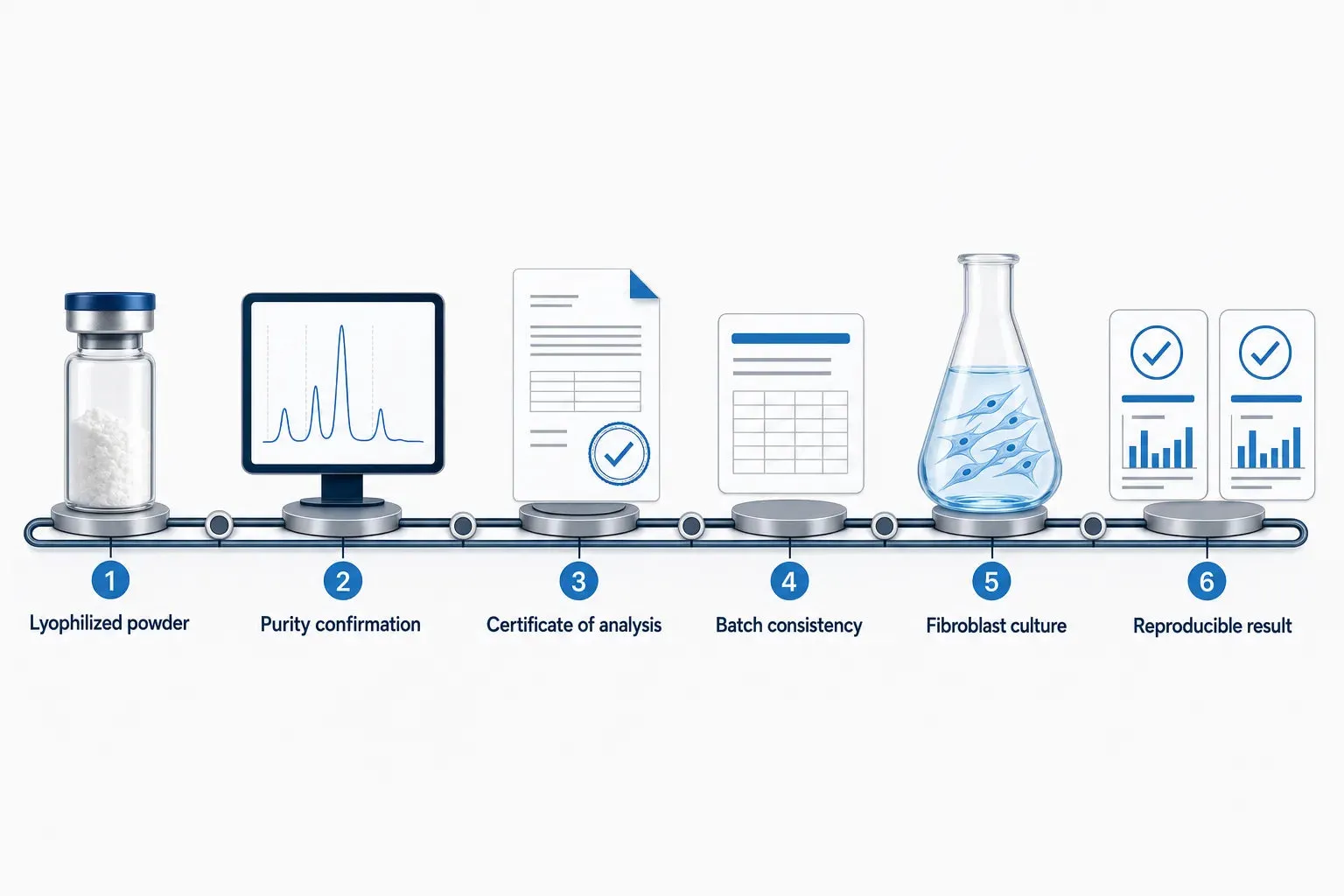
Inconsistent peptide quality and insufficient mechanistic validation often limit the reliability of collagen research. Variable purity can compromise fibroblast activation and distort gene expression analysis. Without standardized formulations, experimental reproducibility becomes difficult. High-integrity peptide sourcing is essential for accurate collagen studies.
Prime Lab Peptide delivers research-grade Glow Peptide Blend manufactured under strict quality control and analytical verification. Each batch undergoes purity confirmation to ensure molecular consistency. Our formulations are optimized for collagen gene activation and matrix stabilization. We provide technical documentation and expert support. Contact us today to elevate your collagen research with scientific precision and confidence.
Compounds Discussed in This Article
- Glow – 70mg — the single vial combining the three peptides covered above; also available as Glow – 70mg (10 vials) for longer study runs.
- GHK-Cu – 50mg — the one component with controlled human data on collagen and skin elasticity, available on its own for work that needs to isolate it.
- BPC-157 – 10mg — the repair-side peptide of the blend; its published record is preclinical and centred on tissue and tendon healing rather than collagen output.
- TB-500 – 5mg — full-length thymosin β4 (43 aa), studied for cell migration and angiogenesis, again mostly in preclinical models.
What Gene Expression Data Actually Exists — and On Which Compound
COL1A1, ELN and VCAN have been measured directly in cultured human dermal fibroblasts — but in a study of collagen hydrolysate peptides, not of GHK-Cu, BPC-157 or TB-500. The attribution matters more than the gene list itself.
Dierckx and colleagues exposed human dermal fibroblasts to collagen peptides and quantified transcription by RT-qPCR, reporting increased expression of COL1A1 (type I collagen), ELN (elastin) and VCAN (versican), with confocal immunostaining showing a higher collagen signal in treated cultures (Frontiers in Medicine, 2024, 10.3389/fmed.2024.1397517). That is a cell-culture result obtained with hydrolyzed collagen fragments — a different molecule class from anything in the Glow vial. Pages that reproduce this gene list under a Glow heading are borrowing a result that was never obtained with Glow's components.
The list is still worth knowing, for one reason: it goes beyond collagen. Elastin governs recoil and versican governs the hydrated ground substance the fibrils sit in, so a collagen-only readout describes part of the matrix and calls it the whole. Any dermal model that reports only procollagen is measuring one of three structural outputs.
Two frequent additions do not survive checking. Suppression of MMP1 and MMP3 is often cited alongside these genes, but that study did not measure matrix metalloproteinases at all. And gene-level claims for GHK itself trace mainly to Pickart and Margolina's 2018 review in the International Journal of Molecular Sciences — a narrative review by the peptide's discoverer, written from a commercial R&D affiliation. It is a useful map of what has been claimed for GHK, and weaker as independent confirmation. No comparable transcriptomic dataset in dermal fibroblasts exists for BPC-157 or TB-500.
Why a Blend Rather Than a Single Peptide
No published study has compared Glow's three peptides together against any one of them alone. The case for the blend format is mechanistic, not experimental — and that distinction should be held onto before reading anything described as synergy.
The mechanistic argument rests on the three components acting on non-overlapping parts of tissue remodeling:
- GHK-Cu — the matrix arm. Reviewed as regulating gene networks tied to collagen, elastin and glycosaminoglycan synthesis, and the only component with controlled human skin work behind it.
- BPC-157 — the vascular and granulation arm. Its published endpoints are angiogenesis and wound or tendon healing, almost entirely in rodent models.
- TB-500 (thymosin β4) — the migration arm. An actin-sequestering peptide studied for keratinocyte and endothelial cell movement rather than for matrix output.
Stacked on paper, matrix synthesis plus vascular supply plus cell migration are the three arms of remodeling. That reasoning is what the vial is built on. What nobody has published is whether combining them is additive, redundant, or mutually interfering in the same preparation — all three outcomes remain open, and the literature does not currently distinguish between them.
One specific unknown sits underneath the format. GHK is a copper-binding peptide whose activity depends on copper coordination, and no published work characterizes how the other two components behave alongside a copper complex in the same solution. A blend can therefore differ from the sum of its parts for chemical reasons, not only biological ones.
Work that needs to attribute an effect to one component rather than to the mixture generally runs the isolate separately, which is why GHK-Cu – 50mg is supplied on its own alongside Glow – 70mg and Glow – 70mg (10 vials).
What Is Still Unknown About Glow and Collagen
Enough remains unmeasured that no magnitude, timeline or durability figure for the blend can be stated from the literature. Naming the gaps is more useful than filling them with numbers borrowed from adjacent compounds.
- Durability after exposure ends. Fibroblast studies report transcription at fixed timepoints during exposure. How long an elevated COL1A1 signal persists once the peptide is withdrawn is not characterized, so claims about lasting matrix change extrapolate past the data.
- Cell types beyond fibroblasts. Keratinocytes, endothelial cells and resident immune cells all shape what the matrix becomes. Almost all peptide collagen work isolates fibroblasts, which removes the crosstalk that decides the outcome in intact tissue.
- Route comparability. GHK-Cu's controlled human evidence comes from topical cosmetic formulations. Nothing published bridges that evidence to a reconstituted lyophilized powder, and the two cannot be treated as interchangeable readouts.
- The ratio inside the vial. The proportion of the three peptides in a 70 mg blend is a formulation decision. No dose-response study exists for that ratio, so there is no experimental basis for calling it optimal rather than simply chosen.
- Independence of sources. A large share of the GHK literature originates with parties holding a commercial interest in the peptide. Independent replication is thin relative to the volume of claims.
- Head-to-head comparison. No study places the blend against GHK-Cu alone under matched conditions, which is the single experiment that would show whether the blend format contributes anything to collagen output.
Until those are addressed, the defensible reading is the one the evidence supports: component-level data of unequal strength, with the collagen case resting on GHK-Cu and the remaining two peptides carrying preclinical records built on other endpoints entirely.
FAQs
How Does Glow Peptide Blend Influence Collagen Cross-Linking and Fibril Maturation?
Glow Peptide Blend may support collagen cross-linking by promoting proper enzymatic processing of procollagen into mature fibrils. Enhanced lysyl oxidase activity and improved extracellular assembly strengthen collagen architecture. As a result, fibrils demonstrate improved tensile strength and structural stability within controlled dermal regeneration models.
Can the Glow Peptide Blend Affect the Balance of Collagen Types in the Dermis?
Yes. Experimental peptide stimulation may influence the type I/type III collagen ratio by modulating gene expression profiles. Maintaining this balance is essential for dermal resilience and elasticity. Therefore, regulated collagen subtype expression supports structured matrix remodeling and prevents disorganized fibrillar deposition.
How Long Do Collagen Changes Last in Research Models?
Glow Peptide Blend may enhance long-term collagen stability by simultaneously stimulating synthesis and reducing degradation pathways. By moderating matrix metalloproteinases and reinforcing fibrillar organization, peptides contribute to sustained extracellular matrix integrity during extended in vitro or three-dimensional dermal studies.
How Does Cellular Energy Metabolism Impact Peptide-Induced Collagen Production?
Collagen synthesis requires significant cellular energy. Glow Peptide Blend may indirectly support mitochondrial efficiency and ATP availability within fibroblasts. Improved metabolic capacity enhances protein translation and matrix assembly processes. Consequently, optimized cellular energy status strengthens collagen output in experimental settings.
Can Glow Peptide Blend Influence Fibroblast Senescence Markers?
Emerging evidence suggests that peptide stimulation may reduce markers of fibroblast senescence, including altered morphology and reduced proliferative capacity. By restoring cellular responsiveness and matrix production potential, Glow Peptide Blend may improve the functional longevity of fibroblasts in controlled dermal aging models.
Does Glow Peptide Blend Interact with Growth Factors Involved in Collagen Regulation?
Glow Peptide Blend may modulate growth factor signaling, including pathways linked to connective tissue growth factor and transforming growth factor activity. This interaction supports coordinated collagen transcription and extracellular assembly. Therefore, peptide-driven signaling enhances structured regenerative responses within fibroblast populations.
References
1-Fisher, G. J., et al. (2002). Mechanisms of photoaging and chronological skin aging. Journal of Investigative Dermatology, 119(2), 357–364.
2-Ricard-Blum, S. (2011). The collagen family. Biomolecules, 1(4), 589–612.


