


KPV – 5mg
Certificates of Analysis
KPV is a synthetic tripeptide composed of lysine, proline and valine, corresponding to residues 11-13 at the C-terminus of alpha-melanocyte-stimulating hormone. It is studied as a structurally minimal fragment of that hormone, which is precisely what makes it useful as a laboratory tool: it allows investigators to ask which properties of the parent sequence persist once the rest of the molecule is removed.
The published literature on KPV is concentrated in gastrointestinal inflammation research. The reported anti-inflammatory activity is described as independent of the melanocortin receptor MC1R, which distinguishes the fragment from the parent hormone. Cellular entry is described as PepT1-mediated, with the di- and tripeptide transporter of intestinal epithelial and immune cells carrying the intact peptide into the cell. In experimental colitis models, the reported readouts include pro-inflammatory cytokine expression and NF-kB pathway activation.
A second research axis is delivery. Nanoparticle and hydrogel carriers have been used to concentrate the tripeptide at the colon rather than distribute it systemically. A related line of work examines the PepT1 transporter in colitis-associated tumorigenesis models, which is why the transporter itself recurs as a variable in this field.
The evidence base is in vitro and rodent; no clinical data are presented, and no human dosing or administration route is described anywhere in this material. This product is supplied for laboratory research use only and is not intended for human or veterinary use, diagnostic procedures, or any therapeutic application.
Couldn't load pickup availability
Need reconstitution solution? Don’t forget to add Bacteriostatic Water before checkout.


C-Terminal Tripeptide of Alpha-MSH
The Three-Residue Fragment Lys-Pro-Val Studied for Anti-Inflammatory Signaling
KPV is a synthetic tripeptide corresponding to residues 11-13 (Lys-Pro-Val) at the C-terminus of alpha-melanocyte-stimulating hormone. Despite its minimal length, published work reports anti-inflammatory activity for this fragment in cell culture and in rodent models, and describes that activity as not requiring engagement of the melanocortin receptor MC1R, which is what distinguishes the fragment from the parent hormone. That dissociation is what makes the tripeptide useful as a structurally simple tool compound: it lets investigators examine melanocortin-derived signaling separately from the receptor pharmacology of the full-length sequence. The evidence summarized here is entirely preclinical, drawn from in vitro systems and rodent models.
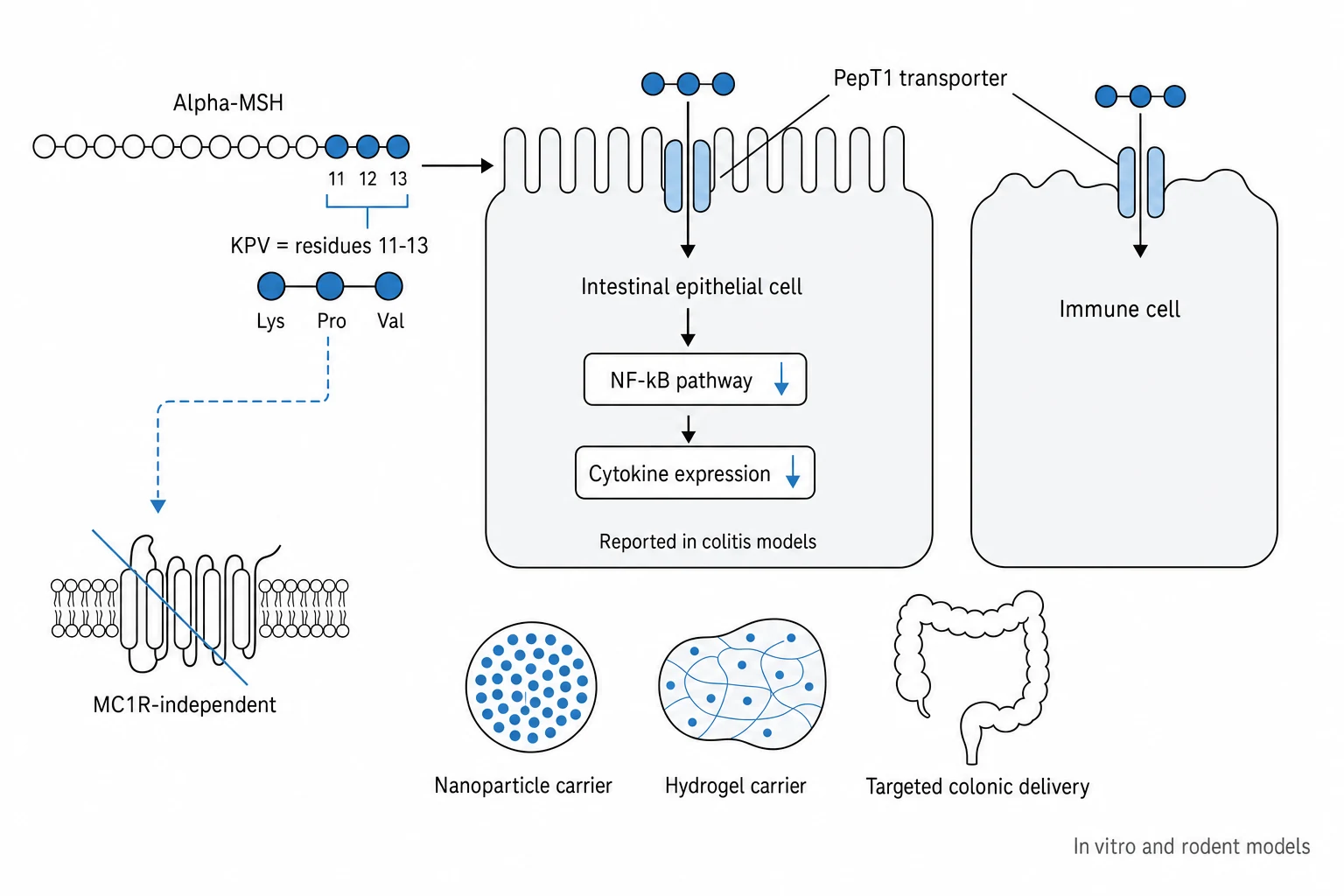
PepT1 Uptake & NF-kB Signaling
How KPV Enters Intestinal Cells and Modulates Inflammatory Pathways
Published work describes cellular entry of KPV as PepT1-mediated: the di- and tripeptide transporter expressed on intestinal epithelial and immune cells is reported to carry the intact tripeptide into the cell rather than leaving it to act at a surface receptor. Downstream of that uptake, experimental colitis models are reported to show reduced expression of pro-inflammatory cytokines together with lower activation of the NF-kB pathway. Those two readouts are how investigators characterize an intracellular mode of action for a three-residue fragment. Everything summarized here comes from in vitro systems and rodent colitis models; no human pharmacology is described, and each result belongs to the model in which it was obtained.

Research Applications
From Experimental Colitis Models to Targeted Colonic Delivery Systems
Most published KPV work sits in gastrointestinal inflammation research, where the tripeptide is examined in experimental colitis models. A second, formulation-driven line of work uses nanoparticle and hydrogel carriers to target the colon, the stated objective being to raise the local concentration of the peptide at the tissue of interest rather than rely on systemic exposure. A third context is colitis-associated tumorigenesis models, in which the PepT1 transporter itself is the object of study rather than any effect attributed to the tripeptide. These are mechanism and delivery studies conducted in cell culture and in rodents; the published record described here contains no clinical investigation, and every readout should be treated as specific to its model.

The Science Behind KPV: Melanocortin-Derived Signaling Without MC1R
KPV is the C-terminal tripeptide of alpha-melanocyte-stimulating hormone, the fragment formed by residues 11-13. What makes it interesting to researchers is what it leaves out: published work reports that its anti-inflammatory activity does not require MC1R engagement, which separates the observed effects from the receptor-mediated signaling of the full-length hormone. That dissociation is the central question the literature addresses.
The uptake route is the second pillar. Rather than acting from the outside of the cell, KPV is described as being carried into intestinal epithelial and immune cells by PepT1, the di- and tripeptide transporter. Investigators study the transporter both as the entry route for the peptide and as a variable of the models themselves, including in work on colitis-associated tumorigenesis, where PepT1 rather than the tripeptide is the object of investigation.
Downstream, reports in experimental colitis converge on reduced pro-inflammatory cytokine expression and dampened NF-kB pathway activation. A parallel body of work is formulation-driven: nanoparticle and hydrogel carriers are designed to raise the local concentration of the tripeptide at the colon instead of relying on systemic exposure.
The honest summary of the evidence is that it is preclinical. Published findings on KPV come from in vitro systems and rodent models, and the delivery work in particular remains at the proof-of-concept stage. No human data are described, and no dosing, route, or administration scheme should be inferred from this material. Researchers should treat published results as model-specific and design their own controls accordingly.
Scientific Literature
- Getting SJ, et al. Dissection of the anti-inflammatory effect of the core and C-terminal (KPV) alpha-melanocyte-stimulating hormone peptides. J Pharmacol Exp Ther. 2003;306(2):631-637.
- Dalmasso G, et al. PepT1-mediated tripeptide KPV uptake reduces intestinal inflammation. Gastroenterology. 2008;134(1):166-178.
- Kannengiesser K, et al. Melanocortin-derived tripeptide KPV has anti-inflammatory potential in murine models of inflammatory bowel disease. Inflamm Bowel Dis. 2008;14(3):324-331.
- Laroui H, et al. Drug-loaded nanoparticles targeted to the colon with polysaccharide hydrogel reduce colitis in a mouse model. Gastroenterology. 2010;138(3):843-853.e1-2.
- Viennois E, et al. Critical role of PepT1 in promoting colitis-associated cancer and therapeutic benefits of the anti-inflammatory PepT1-mediated tripeptide KPV in a murine model. Cell Mol Gastroenterol Hepatol. 2016;2(3):340-357.
- Xiao B, et al. Orally targeted delivery of tripeptide KPV via hyaluronic acid-functionalized nanoparticles efficiently alleviates ulcerative colitis. Mol Ther. 2017;25(7):1628-1640.
Packaged with care, shipped fast.
We’re a passionate team obsessed with quality, not margins.
- Company
- Price
- Purity
- Quantity
- Shipping
-
TB-500 – 5mg
-
Prime
Lab PeptidesTypical
Competitor -
$45.00$80.00
- ≥99%97%
- 5mg5mg
- Free 2-Day Shipping3-10 Business Day
-


