All product descriptions and articles provided on this website are intended strictly for informational and educational purposes. Our products are designed exclusively for in-vitro research (i.e., experiments conducted outside of a living organism, typically in glassware such as test tubes or petri dishes). These compounds are not approved by the FDA for use in humans or animals. They are not medications, nor are they intended to diagnose, treat, prevent, or cure any disease or medical condition. Any bodily administration-human or animal-is strictly prohibited by law. Our products are not for human consumption under any circumstances.
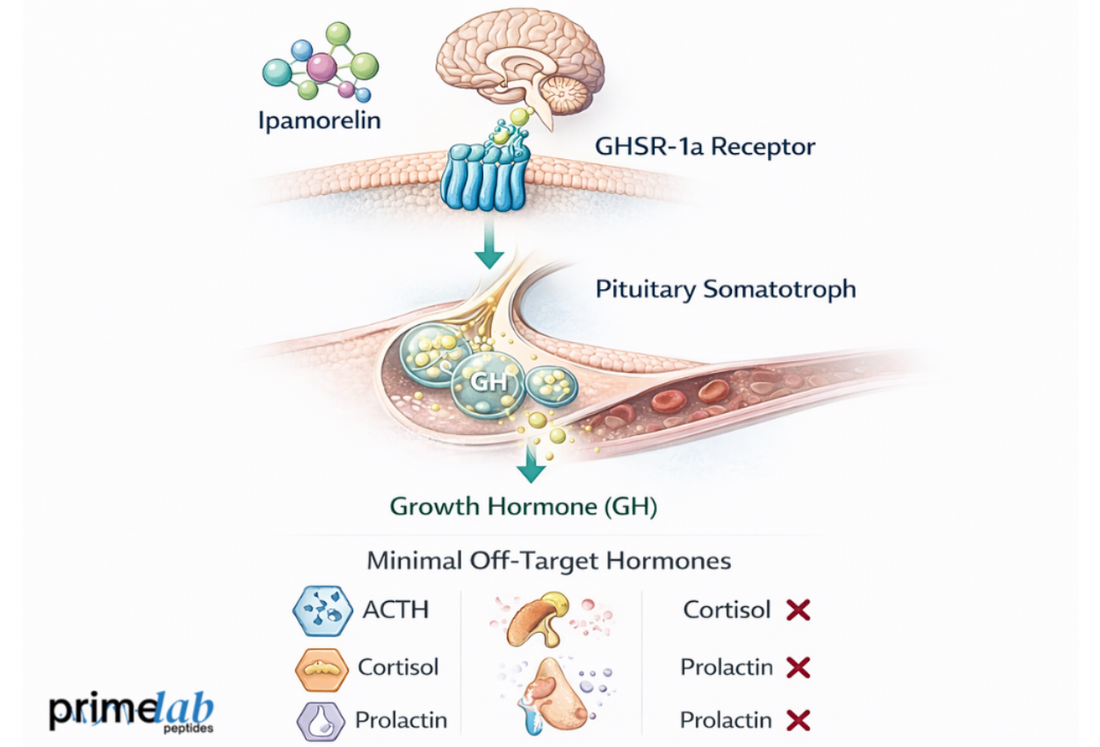
Ipamorelin achieves targeted growth hormone (GH) secretion primarily by selectively activating the growth hormone secretagogue receptor (GHSR-1a) in the anterior pituitary and hypothalamus. Unlike earlier growth hormone secretagogues, ipamorelin demonstrates a high degree of receptor specificity, thereby minimizing stimulation of other pituitary hormones, such as prolactin, cortisol, and adrenocorticotropic hormone (ACTH).
As a synthetic pentapeptide belonging to the ghrelin-mimetic family, ipamorelin interacts with endocrine signaling pathways that regulate pulsatile GH release. Research described in the European Journal of Endocrinology [1] demonstrates that ipamorelin stimulates GH secretion while showing minimal activity on other pituitary hormone axes compared with first-generation secretagogues. This pharmacological selectivity is considered a defining characteristic of the peptide.
Prime Lab Peptides operates as a research-focused supplier, providing peptides with comprehensive analytical characterization, batch validation documentation, and traceable quality control data. These structured quality systems assist investigators conducting receptor-binding studies, endocrine signaling analyses, and peptide pharmacology research requiring reproducibility and molecular consistency.
How Does GHSR-1a Receptor Selectivity Enable Targeted GH Release?
GHSR-1a receptor selectivity enables targeted GH release by restricting ipamorelin’s activity to signaling pathways that specifically regulate somatotroph secretion. According to Molecular Metabolism [2], the receptor is predominantly expressed in pituitary somatotroph cells responsible for GH production and in hypothalamic regions such as the arcuate nucleus, which coordinates endocrine feedback loops and systemic energy metabolism.
Pharmacological research demonstrates several mechanisms contributing to this selectivity:
- High Receptor Affinity: Ipamorelin binds to GHSR-1a receptors with high affinity, triggering intracellular signaling cascades associated with GH secretion.
- Minimal Non-Specific Pituitary Activation: Unlike early secretagogues such as GHRP-2 or GHRP-6, ipamorelin shows limited stimulation of ACTH, prolactin, or cortisol pathways.
- Controlled Intracellular Signaling: Activation of GHSR-1a initiates calcium-dependent signaling in somatotroph cells, promoting GH vesicle release without broadly stimulating neighboring endocrine pathways.
Experimental investigations evaluating growth hormone secretagogues report that receptor specificity significantly influences endocrine selectivity. Because ipamorelin preferentially targets GHSR-1a, it produces a narrower hormonal response profile than less selective peptides.
What Molecular Characteristics Support Ipamorelin’s Hormonal Specificity?
Ipamorelin’s hormonal specificity arises from its molecular structure, which enables selective receptor interaction and limited cross-reactivity with other endocrine receptors. As a short pentapeptide, ipamorelin contains a defined amino acid sequence designed to mimic functional regions of endogenous ghrelin while avoiding structural motifs associated with broader pituitary stimulation. This compact structure supports precise interaction with the growth hormone secretagogue receptor (GHSR-1a).
Another factor contributing to this specificity is its optimized binding conformation. Structural modeling studies suggest that ipamorelin’s peptide backbone aligns efficiently with the GHSR-1a receptor binding pocket, promoting targeted receptor activation. Because of this structural compatibility, intracellular signaling pathways primarily associated with growth hormone release are preferentially stimulated rather than broader endocrine pathways.
Additionally, structural refinement reduces interaction with non-target receptors that regulate hormones such as cortisol or prolactin. Peptide pharmacology research indicates that small variations in peptide structure can strongly influence receptor affinity and signaling bias. In ipamorelin’s case, these molecular characteristics support selective GH stimulation while limiting broader endocrine activation.

How Does Pituitary Signaling Control the Selective GH Response?
Pituitary signaling controls the selective GH response by integrating receptor activation with intracellular pathways specific to somatotroph cells. Once ipamorelin binds to GHSR-1a, it activates G-protein-coupled receptor signaling that triggers calcium influx and cyclic signaling pathways associated with GH vesicle exocytosis.
Several mechanisms explain how this signaling remains selective:
-
Somatotroph-Specific Signaling
Somatotroph cells contain specialized secretory granules that store growth hormone. Activation of intracellular calcium pathways promotes the release of GH from these granules without activating unrelated endocrine cell populations.
-
Interaction With Hypothalamic Feedback Loops
Ipamorelin also interacts with hypothalamic signaling networks involving growth hormone-releasing hormone (GHRH) and somatostatin. These regulatory loops refine the amplitude and timing of GH pulses.
-
Limited Corticotropic Activation
Pharmaceutical Research [4] demonstrates that ipamorelin produces minimal stimulation of ACTH and cortisol compared with earlier secretagogues. This reduced activity suggests that receptor signaling remains largely confined to GH-related pathways.
Together, these mechanisms illustrate how receptor activation and intracellular signaling work together to produce selective endocrine responses. This integrated regulatory framework helps maintain endocrine precision while minimizing unintended hormonal activation during controlled physiological or experimental signaling processes.
How Do Experimental Studies Evaluate Off-Target Hormonal Effects?
Experimental studies evaluate off-target hormonal effects by measuring multiple endocrine markers following peptide administration. These assessments typically involve controlled laboratory models where researchers monitor circulating levels of hormones such as cortisol, prolactin, ACTH, and GH.
Pharmacological research commonly examines several indicators:
- Hormone Panel Measurements: Blood samples are analyzed to determine whether GH stimulation is accompanied by changes in other pituitary hormones.
- Receptor-Binding Assays: Laboratory experiments measure the binding affinity of peptides to different receptor subtypes.
- Comparative Secretagogue Studies: Ipamorelin is often evaluated alongside other growth hormone secretagogues to compare hormonal response profiles.
Studies in Endocrine Reviews [3] comparing several secretagogues report that ipamorelin exhibits one of the most selective GH-release profiles within this peptide class. These findings support the idea that receptor specificity and structural design help reduce off-target endocrine activation.
Advance Targeted Endocrine Research With Selective GH Secretagogue Peptides
Researchers frequently encounter challenges when evaluating endocrine signaling pathways, including limited receptor specificity, inconsistent peptide characterization, and variability in hormonal assay results. These factors complicate investigations focused on growth hormone regulation, receptor pharmacology, and pituitary signaling dynamics. Additionally, insufficient documentation regarding peptide purity or analytical validation may introduce uncertainty in experimental interpretation.
Prime Lab Peptides supports structured research workflows by supplying ipamorelin with defined purity specifications, validated analytical characterization, and transparent batch documentation. These quality standards enable investigators to evaluate receptor-binding interactions, endocrine signaling pathways, and GH-related pharmacological responses under controlled experimental conditions. For detailed analytical specifications or technical discussion regarding peptide research applications, contact us to continue the conversation.

FAQs
What receptor does ipamorelin primarily activate?
Ipamorelin primarily activates the growth hormone secretagogue receptor GHSR-1a. This receptor is expressed in the anterior pituitary and hypothalamus and regulates pulsatile growth hormone secretion. When ipamorelin binds to GHSR-1a, it initiates signaling pathways that stimulate somatotroph cells to release growth hormone without broadly activating unrelated endocrine pathways.
Why does ipamorelin produce fewer off-target hormonal effects?
Ipamorelin produces fewer off-target hormonal effects because it demonstrates strong selectivity for the GHSR-1a receptor. This receptor specificity reduces stimulation of other pituitary axes that regulate cortisol, prolactin, or ACTH secretion. As a result, endocrine responses remain largely confined to growth hormone pathways in controlled experimental models.
How does ipamorelin differ from earlier GH secretagogues?
Ipamorelin differs from earlier growth hormone secretagogues because it was designed to improve receptor selectivity and endocrine precision. Many early secretagogues stimulated multiple pituitary hormones simultaneously. In contrast, ipamorelin preferentially activates GHSR-1a signaling pathways, thereby enabling targeted growth hormone release while reducing stimulation of other hormonal systems.
What determines whether a peptide causes off-target hormonal activation?
Several factors determine whether a peptide causes off-target hormonal activation, including receptor specificity, molecular structure, and signaling bias. Peptides that bind multiple receptors or trigger broader intracellular signaling pathways are more likely to stimulate unrelated endocrine systems, leading to hormonal responses beyond the intended physiological target.
What limits the interpretation of GH secretagogue research?
Interpretation of growth hormone secretagogue research may be limited by differences in experimental models, receptor distribution, and measurement techniques. Hormonal responses can also vary depending on peptide concentration, timing of hormone sampling, and study design. Controlled laboratory conditions are therefore essential for accurately evaluating the effects of endocrine signaling.
References
2-Müller, T. D., et al. (2015). Ghrelin. Molecular Metabolism, 4(6), 437–460.