


Tesamorelin – 10mg
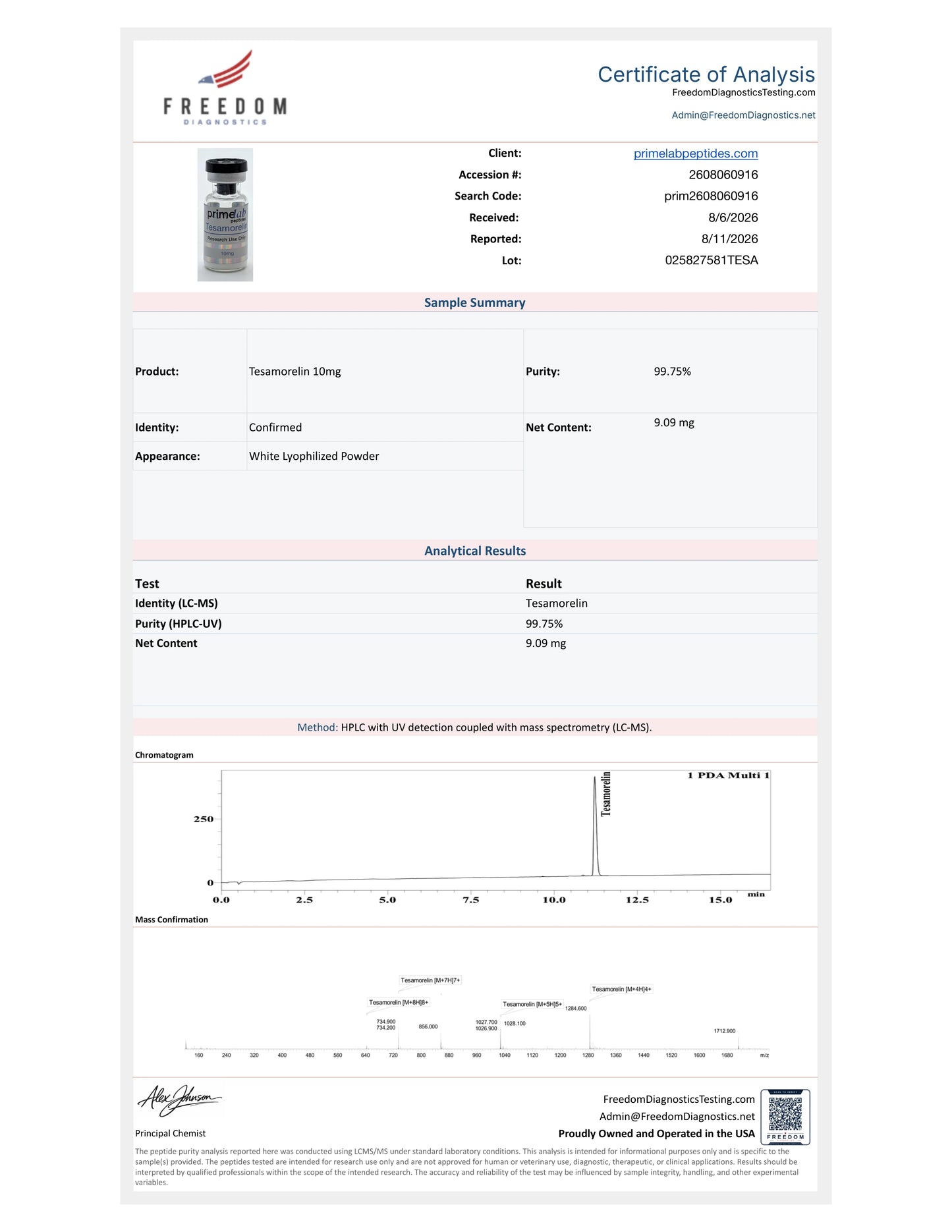
Certificates of Analysis
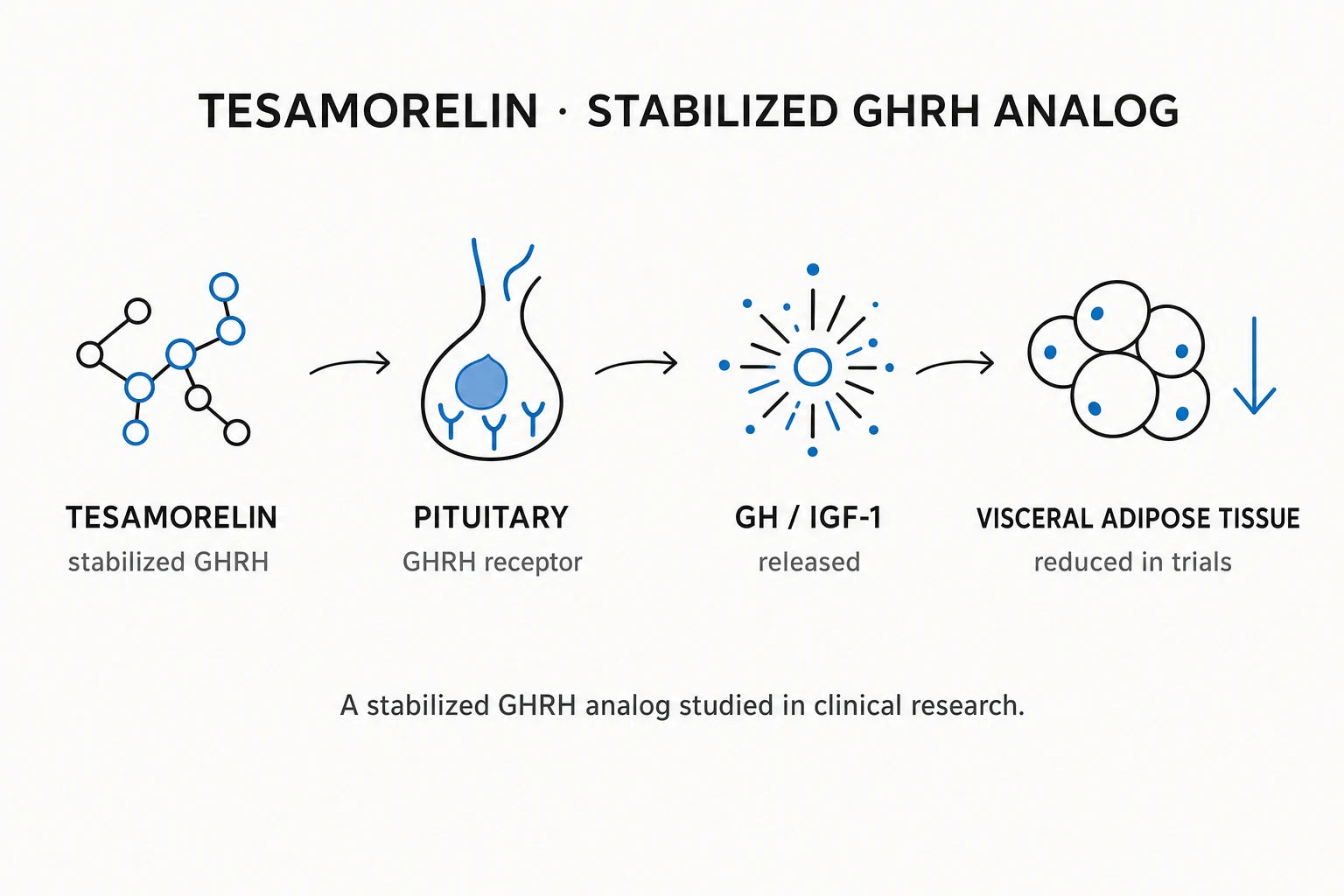
Tesamorelin is a stabilized GHRH analog, and the only GHRH analog whose molecule has reached approval as a prescription medicine (Egrifta) — an approval that covers that finished drug product, not the research material supplied here. It has been studied specifically for deep abdominal (visceral) fat.
In a randomized human trial, daily tesamorelin reduced visceral adipose tissue by 18% over 52 weeks and lowered triglycerides, without clinically significant changes in glucose[1].
It acts on the pituitary GHRH receptor to restore GH/IGF-1 signaling; visceral fat re-accumulates once treatment stops, underlining that the effect is treatment-dependent.
Supplied as a lyophilized powder for reconstitution. Figures above summarize published clinical research on this molecule and are provided as scientific reference for laboratory research only.
Couldn't load pickup availability
Need reconstitution solution? Don’t forget to add Bacteriostatic Water before checkout.

GHRH Analog
A Stabilized GHRH Analog: Mechanism and Metabolic Research
Tesamorelin is a 44-amino-acid synthetic GHRH analog with a trans-3-hexanoic acid modification that increases plasma stability and half-life. It preserves physiological pulsatile GH secretion while delivering clinically validated results — reducing visceral adiposity by nearly 20% as reported in the published lipodystrophy trials. This makes tesamorelin the gold standard for metabolic and body composition research.
- 44-amino-acid GHRH analog with enhanced stability
- Trans-3-hexanoic acid modification extends half-life
- Preserves physiological pulsatile GH release
- ~20% reduction in visceral adiposity
- Extended plasma stability from the trans-3-hexanoic acid modification
Metabolic & Cardiovascular Research
How Tesamorelin Targets Visceral Fat and Cardiovascular Risk
Tesamorelin stimulates the pituitary to release GH in natural pulses, which then drives IGF-1 production and metabolic optimization. Research demonstrates significant reductions in triglycerides, total cholesterol, and non-HDL-C — a 15% reduction in visceral adipose tissue correlates with a 50 mg/dL decrease in triglycerides. By reducing ectopic fat deposition, tesamorelin directly decreases the inflammation that drives cardiovascular disease risk.
- Stimulates pulsatile GH release via GHRH receptor
- Increases IGF-1 levels physiologically
- Reduces triglycerides, total cholesterol, non-HDL-C
- 15% visceral fat reduction = 50 mg/dL triglyceride drop
- Decreases ectopic fat-driven inflammation
Expanding Research Applications
From Nerve Regeneration to Cognitive Protection
Beyond metabolic research, tesamorelin shows promise in peripheral nerve regeneration and mild cognitive impairment (MCI). A randomized, double-blind trial at the University of Washington demonstrated that tesamorelin improves executive function and verbal memory in MCI patients — potentially by increasing brain GABA levels and decreasing myo-inositol. Its existing regulatory pathway makes it an attractive candidate for clinical translation.
- Peripheral nerve regeneration studies
- Mild cognitive impairment (MCI) research
- Increases brain GABA levels
- Improves executive function and verbal memory
- Extensively characterized in published clinical research

The Science Behind GHRH Signaling: Why Tesamorelin Leads Metabolic Research
Tesamorelin represents the pinnacle of GHRH analog development. As a 44-amino-acid synthetic peptide with a trans-3-hexanoic acid modification, it achieves enhanced plasma stability while preserving the physiological pulsatile pattern of GH release. This is a critical distinction from exogenous GH administration, which obliterates natural secretory rhythms and causes more side effects.
The clinical data is compelling. In lipodystrophy research, tesamorelin reduced visceral adiposity by nearly 20% — approximately 4× more effective than all other available interventions combined. Beyond fat reduction, it improved the entire metabolic profile: triglycerides dropped in direct correlation with visceral fat loss (15% fat reduction = 50 mg/dL triglyceride decrease), and total cholesterol and non-HDL-C levels improved significantly.
The cardiovascular implications are profound. Ectopic fat deposition — visceral, hepatic, and epicardial — drives chronic inflammation that underlies cardiovascular disease. By specifically targeting this dysfunctional fat accumulation, tesamorelin addresses root causes rather than symptoms. This makes it particularly valuable for research into metabolic syndrome, insulin resistance, and age-related body composition changes.
Emerging research extends beyond metabolism. A 20-week randomized controlled trial demonstrated that tesamorelin improves executive function and verbal memory in patients with mild cognitive impairment — potentially by increasing brain GABA levels and decreasing myo-inositol. Peripheral nerve regeneration studies show similar promise. For research teams investigating GH physiology, metabolic dysfunction, neuroprotection, or cardiovascular risk, tesamorelin provides a clinically validated, physiologically appropriate tool with an established regulatory pathway.
For research use only. Not for human consumption.
Scientific Literature
- Wang Y, Tomlinson B. Tesamorelin, a human growth hormone releasing factor analogue. Expert Opin Investig Drugs. 2009;18(3):303-10.
- Falutz J, Allas S, Blot K, et al. Metabolic effects of a growth hormone-releasing factor in patients with HIV. N Engl J Med. 2007;357(23):2359-70.
- Falutz J, Mamputu JC, Potvin D, et al. Effects of tesamorelin (TH9507), a growth hormone-releasing factor analog, in human immunodeficiency virus-infected patients with excess abdominal fat: a pooled analysis of two multicenter, double-blind placebo-controlled phase 3 trials with safety extension data. J Clin Endocrinol Metab. 2010;95(9):4291-304.
- Stanley TL, Fourman LT, Feldpausch MN, et al. Effects of tesamorelin on non-alcoholic fatty liver disease in HIV: a randomised, double-blind, multicentre trial. Lancet HIV. 2019;6(12):e821-e830.
- Badran AS, Helal A, Shata KS, Ayesh H. Body composition, hepatic fat, metabolic, and safety outcomes of Tesamorelin, a GHRH analogue, in HIV-associated lipodystrophy: A meta-analysis of randomized controlled trials. Obes Res Clin Pract. 2026;20(1):2-12.
Packaged with care, shipped fast.
We’re a passionate team obsessed with quality, not margins.
- Company
- Price
- Purity
- Quantity
- Shipping
-

Tesamorelin – 10mg
-
Prime
Lab PeptidesTypical
Competitor -
$85.00$155.00
- ≥99%95%
- 10mg10mg
- Free 2-Day Shipping3-10 Business Day
-


