


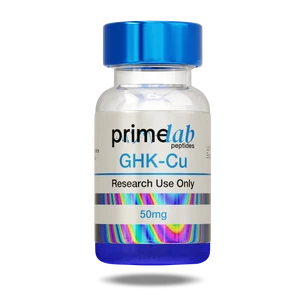
GHK-Cu – 50mg
Certificates of Analysis
GHK-Cu is the human copper-binding tripeptide (glycyl-L-histidyl-L-lysine + copper) — a natural signal for skin remodeling and repair whose levels decline with age.
In controlled studies on aged skin, GHK-Cu tightened skin, improved elasticity and firmness, and reduced fine lines, wrinkles and photodamage; mechanistically it boosts collagen and elastin synthesis and fibroblast proliferation[1].
Beyond skin, GHK-Cu acts as a broad regenerative signal — antioxidant and anti-inflammatory — and up- and down-regulates a large set of human genes tied to tissue repair[2].
Supplied as a lyophilized powder for reconstitution. Figures above summarize published cosmetic and preclinical research on this molecule and are provided as scientific reference for laboratory research only.
Couldn't load pickup availability
Need reconstitution solution? Don’t forget to add Bacteriostatic Water before checkout.
Running a longer study? Save with the 10-vial packGHK-Cu – 50mg (10 Vials) — $385.00 ($38.50/vial) →

Copper Tripeptide Complex
Nature's Signal for Tissue Repair and Regeneration
GHK-Cu is a naturally occurring copper-binding tripeptide found in human blood plasma, saliva, and urine. This small but powerful molecule acts as the body's endogenous repair signal — triggering collagen synthesis, fibroblast activation, and angiogenesis. Research shows GHK-Cu levels decline significantly with age, making it a compelling target for regenerative research.
- Naturally occurring copper peptide complex
- Stimulates collagen and glycosaminoglycan synthesis
- Activates fibroblasts and promotes angiogenesis
- Potent antioxidant properties
- Declines with age — from ~200 ng/mL to ~80 ng/mL

Multi-Pathway Regeneration
How GHK-Cu Orchestrates Tissue Remodeling
GHK-Cu functions as both a copper chaperone and a pro-repair signal. It delivers copper to cuproenzymes like lysyl oxidase (critical for collagen cross-linking) while simultaneously modulating over 4,000 genes involved in tissue repair. The result: balanced matrix remodeling through coordinated MMP/TIMP activity, enhanced decorin expression, and suppressed inflammatory signaling.
- Delivers copper to lysyl oxidase for collagen cross-linking
- Modulates 4,000+ genes related to tissue repair
- Balances MMPs and TIMPs for healthy matrix turnover
- Upregulates decorin for organized collagen fibrils
- Suppresses inflammatory cytokines (IL-6, TNF-α)

Research Applications
From Wound Healing to Skin Rejuvenation Research
GHK-Cu has been extensively studied for its role in wound healing and tissue regeneration. Human clinical data supports its use in chronic wound care and post-procedure healing, while preclinical research explores applications in skin rejuvenation, hair follicle health, and even nervous system function. Its multifunctional activity makes it invaluable for regenerative research.
- Wound healing and chronic ulcer research
- Skin rejuvenation and anti-aging studies
- Post-procedure tissue recovery modeling
- Hair follicle and dermal papilla research
- Connective tissue and scar formation studies
- Neuroprotective pathway exploration
The Science Behind Copper Peptide: Why GHK-Cu Is Central to Regenerative Research
GHK-Cu (glycyl-L-histidyl-L-lysine:copper complex) represents one of the most extensively studied peptides in regenerative biology. First isolated from human plasma in 1973, this naturally occurring tripeptide has since been shown to influence thousands of genes involved in tissue repair, inflammation control, and matrix remodeling.
What makes GHK-Cu remarkable is its dual function. As a copper chaperone, it safely delivers copper to enzymes essential for collagen and elastin cross-linking (like lysyl oxidase and SOD1). As a signaling molecule, it triggers pro-repair gene programs — stimulating collagen synthesis, glycosaminoglycan production, and decorin expression while balancing the matrix metalloproteinases (MMPs) that remodel damaged tissue.
Human clinical data supports GHK-Cu's role in wound healing (including diabetic ulcer studies) and post-procedure recovery (laser resurfacing trials). Preclinical research continues to expand into hair follicle biology, nervous system function, and age-related tissue decline — driven by the observation that plasma GHK-Cu levels drop from approximately 200 ng/mL in young adults to just 80 ng/mL by age 60.
For research teams investigating tissue regeneration, wound healing, or age-related decline, GHK-Cu provides a well-characterized, multi-pathway tool with decades of scientific literature supporting its biological activity.
For research use only. Not for human consumption.
Scientific Literature
- Pickart L, et al. GHK Peptide as a Natural Modulator of Multiple Cellular Pathways in Skin Regeneration. Biomed Res Int. 2015;2015:648108.
- Bossak-Ahmad K, et al. Ternary Cu(II) Complex with GHK Peptide and L-Urocanic Acid as a Potential Physiologically Functional Copper Chelate. Int J Mol Sci. 2020;21(17):6190.
- Bian Y, et al. The glycyl-L-histidyl-L-lysine-Cu2+ tripeptide complex attenuates lung inflammation and fibrosis in silicosis by targeting peroxiredoxin 6. Redox Biol. 2024;75:103237.
- Fu SC, et al. Tripeptide-copper complex GHK-Cu (II) transiently improved healing outcome in a rat model of ACL reconstruction. J Orthop Res. 2015;33(7):1024-1033.
- Ogorek K, et al. Are We Ready to Measure Skin Permeation of Modern Antiaging GHK-Cu Tripeptide Encapsulated in Liposomes? Molecules. 2025;30(1):136.
Packaged with care, shipped fast.
We’re a passionate team obsessed with quality, not margins.
- Company
- Price
- Purity
- Quantity
- Shipping
-
GHK-Cu – 50mg
-
Prime
Lab PeptidesTypical
Competitor -
$50.00$90.00
- ≥99%96%
- 50mg50mg
- Free 2-Day Shipping3-10 Business Day
-


