


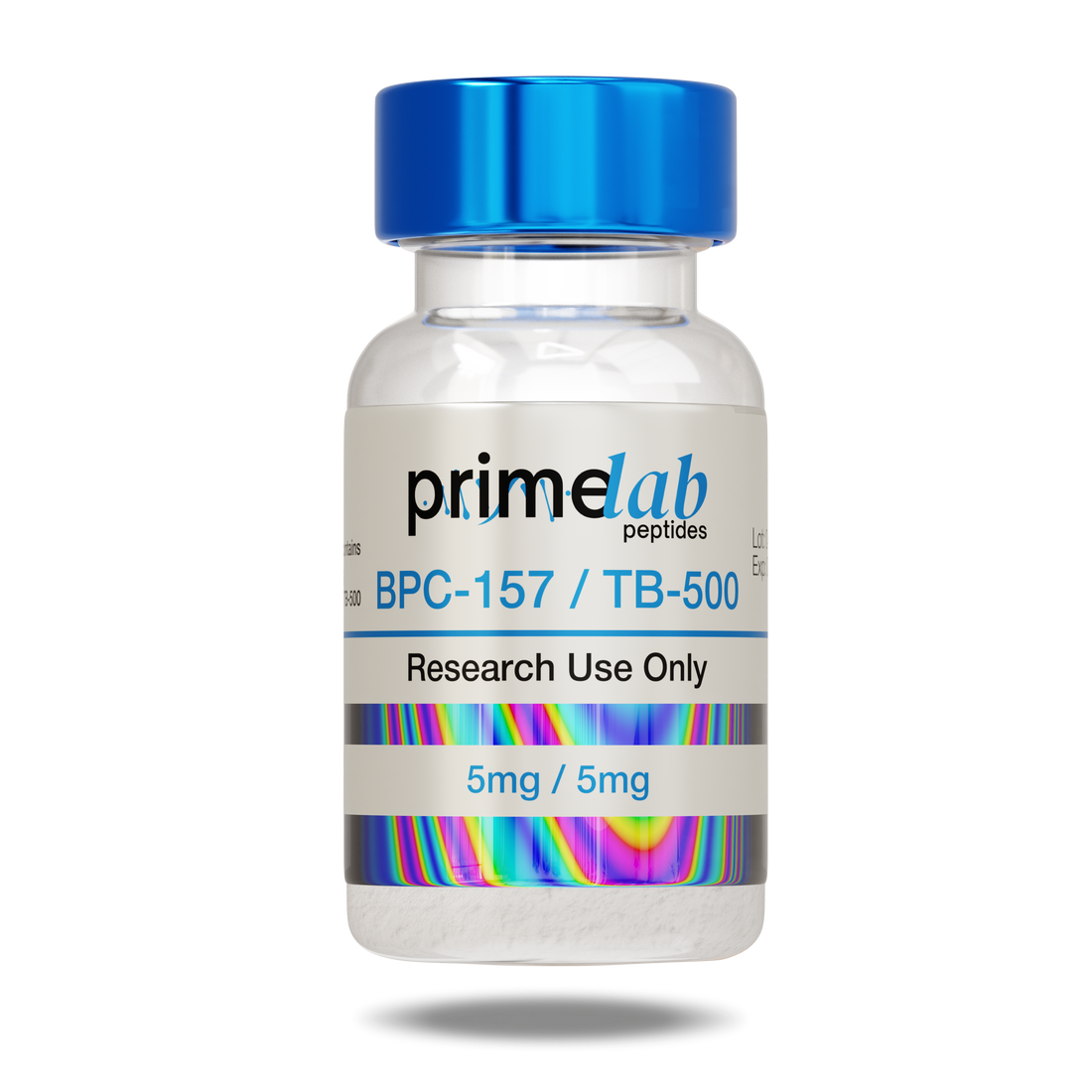
BPC-157 / TB-500 – 5mg / 5mg
Certificates of Analysis
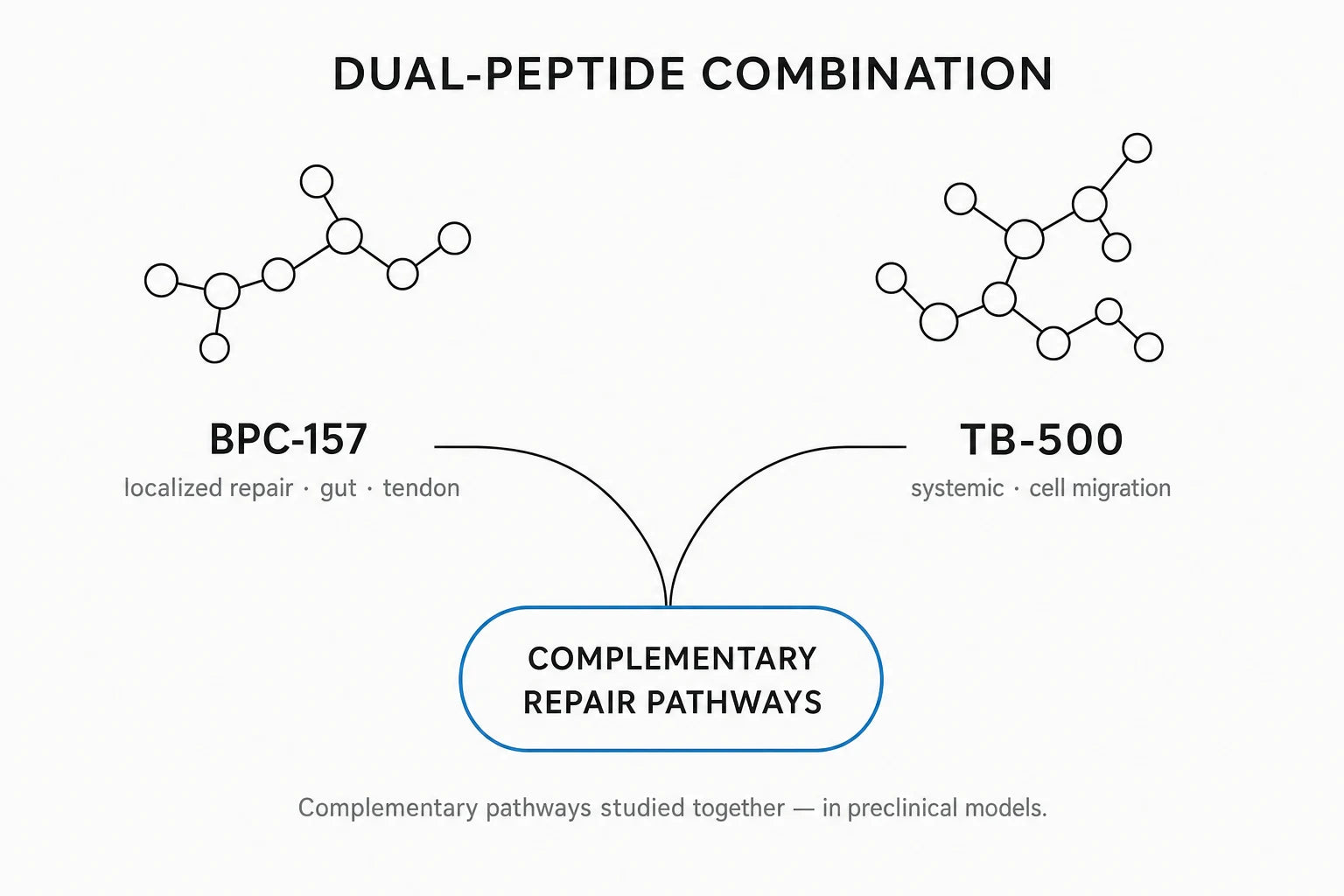
This blend pairs BPC-157 and TB-500 (5 mg each) — two of the most-studied repair peptides — chosen for their complementary mechanisms.
BPC-157 has shown localized effects on tendon, ligament and gut tissue and strong pro-angiogenic activity in preclinical models[1].
TB-500 (thymosin β4) drives systemic cell migration and angiogenesis, accelerating endothelial migration several-fold in preclinical research[2].
Supplied as a two-peptide lyophilized powder for reconstitution. Findings above come from preclinical (animal and cell-based) research on these molecules and are provided as scientific reference for laboratory research only.
Couldn't load pickup availability
Need reconstitution solution? Don’t forget to add Bacteriostatic Water before checkout.
Running a longer study? Save with the 10-vial packBPC-157 / TB-500 – 5mg / 5mg (10 vials) — $590.00 ($59.00/vial) →

Synergistic Repair Blend
Two Peptides, Complementary Pathways: The Definitive Tissue Repair Combination
This blend combines BPC-157 and TB-500 (Thymosin Beta-4) — two of the most extensively studied tissue repair peptides in preclinical research. BPC-157, a stable gastric pentadecapeptide, excels at angiogenesis and growth factor regulation. TB-500, a 43-amino-acid actin-binding protein, drives cell migration and cytoskeletal remodeling. Together, they address multiple aspects of tissue repair simultaneously.
- BPC-157 + TB-500 combined in one formulation
- Complementary mechanisms for comprehensive repair
- BPC-157: Angiogenesis + growth factor signaling
- TB-500: Cell migration + actin regulation
- Synergistic effects demonstrated in research
Actin Regulation & Cell Migration
How Two Peptides Create Synergistic Wound Healing
Successful wound healing depends on fibroblasts and immune cells migrating to injury sites — a process heavily dependent on the protein actin. BPC-157 works at the gene level to increase actin production and upregulates growth hormone receptors on fibroblasts. TB-500 sequesters this actin where it's most useful, building filaments that enable cell movement. Together, they increase both the quantity and function of actin for accelerated repair.
- BPC-157: Increases actin production at gene level
- TB-500: Sequesters actin for filament building
- BPC-157: Upregulates GH receptors on fibroblasts
- TB-500: Provides actin stores for extended cell survival
- Combined effect: Enhanced fibroblast migration to injury
Research Applications
From Tendon Healing to Soft Tissue Regeneration Research
The BPC-157/TB-500 combination enables research across the full spectrum of tissue repair. Studies suggest this blend may lead to faster recovery times and improved structural integrity of repaired tissues. The combination addresses multiple aspects of tissue recovery — blood flow, inflammation, cellular migration, and structural remodeling — making it particularly valuable for musculoskeletal and soft tissue research.
- Tendon and ligament healing research
- Muscle injury and repair modeling
- Wound healing and tissue regeneration studies
- Anti-inflammatory mechanism investigations
- Angiogenesis and blood flow research
- Comparative studies: blend vs. single peptide protocols

The Science Behind Synergistic Repair: Why BPC-157 + TB-500 Work Better Together
The BPC-157/TB-500 blend combines two peptides with overlapping yet distinct pathways in tissue repair. While each peptide is extensively studied on its own, research suggests their combination produces synergistic effects that exceed what either achieves alone.
BPC-157 (Body Protection Compound-157) is a stable gastric pentadecapeptide derived from a protective protein in the stomach lining. It promotes healing through angiogenesis (new blood vessel formation), growth factor regulation, and reduced inflammation. Critically, research shows BPC-157 increases actin production at the gene level and upregulates growth hormone receptor expression on tendon fibroblasts — extending their lifespan and regenerative capacity.
TB-500 (Thymosin Beta-4) is a 43-amino-acid actin-binding protein that plays a key role in cell migration and tissue regeneration. It sequesters actin monomers, directing them to where they're most useful for building the filaments cells need to move. With BPC-157 increasing actin production and GH receptor expression, TB-500 ensures fibroblasts have the cytoskeletal resources to take full advantage of their enhanced signaling and extended survival.
Together, these peptides create a comprehensive repair environment: more actin (BPC-157), better actin utilization (TB-500), enhanced growth hormone sensitivity (BPC-157), and improved cell migration (both). For research teams investigating tissue regeneration, wound healing, or musculoskeletal repair, this combination provides a synergistic platform that addresses multiple aspects of the healing cascade simultaneously.
For research use only. Not for human consumption.
Scientific Literature
- Chang CH, Tsai WC, Lin MS, Hsu YH, Pang JS. The promoting effect of pentadecapeptide BPC 157 on tendon healing involves tendon outgrowth, cell survival, and cell migration. J Appl Physiol (1985). 2011;110(3):774-80.
- Sikiric P, Seiwerth S, Rucman R, et al. Stable gastric pentadecapeptide BPC 157-NO-system relation. Curr Pharm Des. 2014;20(7):1126-35.
- Staresinic M, Sebecic B, Patrlj L, et al. Gastric pentadecapeptide BPC 157 accelerates healing of transected rat Achilles tendon and in vitro stimulates tendocytes growth. J Orthop Res. 2003;21(6):976-83.
- Safer D, Elzinga M, Nachmias VT. Thymosin beta 4 and Fx, an actin-sequestering peptide, are indistinguishable. J Biol Chem. 1991;266(7):4029-32.
- Bock-Marquette I, Saxena A, White MD, Dimaio JM, Srivastava D. Thymosin beta4 activates integrin-linked kinase and promotes cardiac cell migration, survival and cardiac repair. Nature. 2004;432(7016):466-72.
- Guarnera G, De Rosa A, Camerini R. Thymosin beta-4 and venous ulcers: clinical remarks on a European prospective, randomized study on safety, tolerability, and enhancement on healing. Ann N Y Acad Sci. 2007;1112:407-12.
Packaged with care, shipped fast.
We’re a passionate team obsessed with quality, not margins.
- Company
- Price
- Purity
- Quantity
- Shipping
-

BPC-157 / TB-500 – 5mg / 5mg
-
Prime
Lab PeptidesTypical
Competitor -
$70.00$125.00
- ≥99%93%
- 5mg/5mg5mg/5mg
- Free 2-Day Shipping3-10 Business Day
-


