


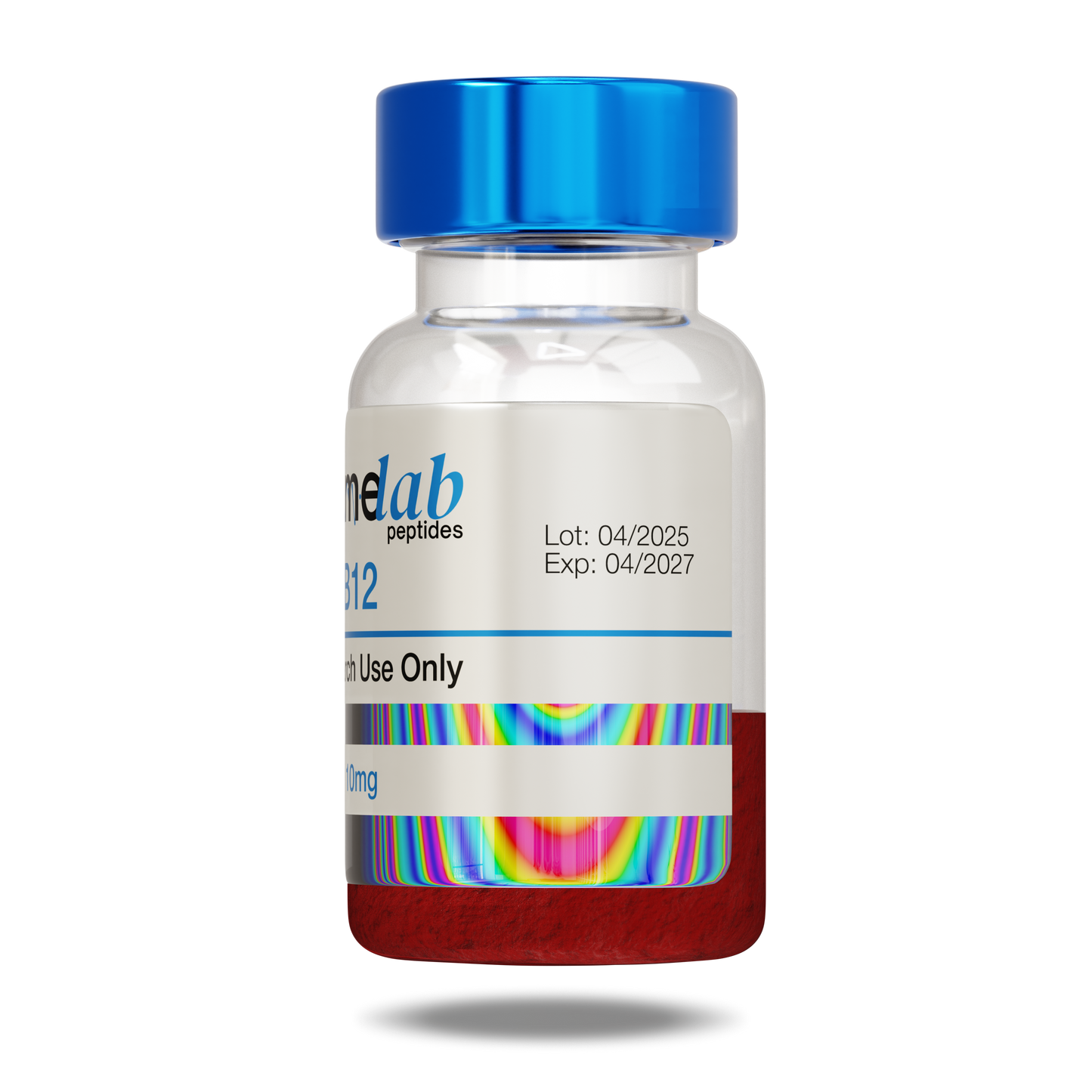
B12 – 10mg
Certificates of Analysis
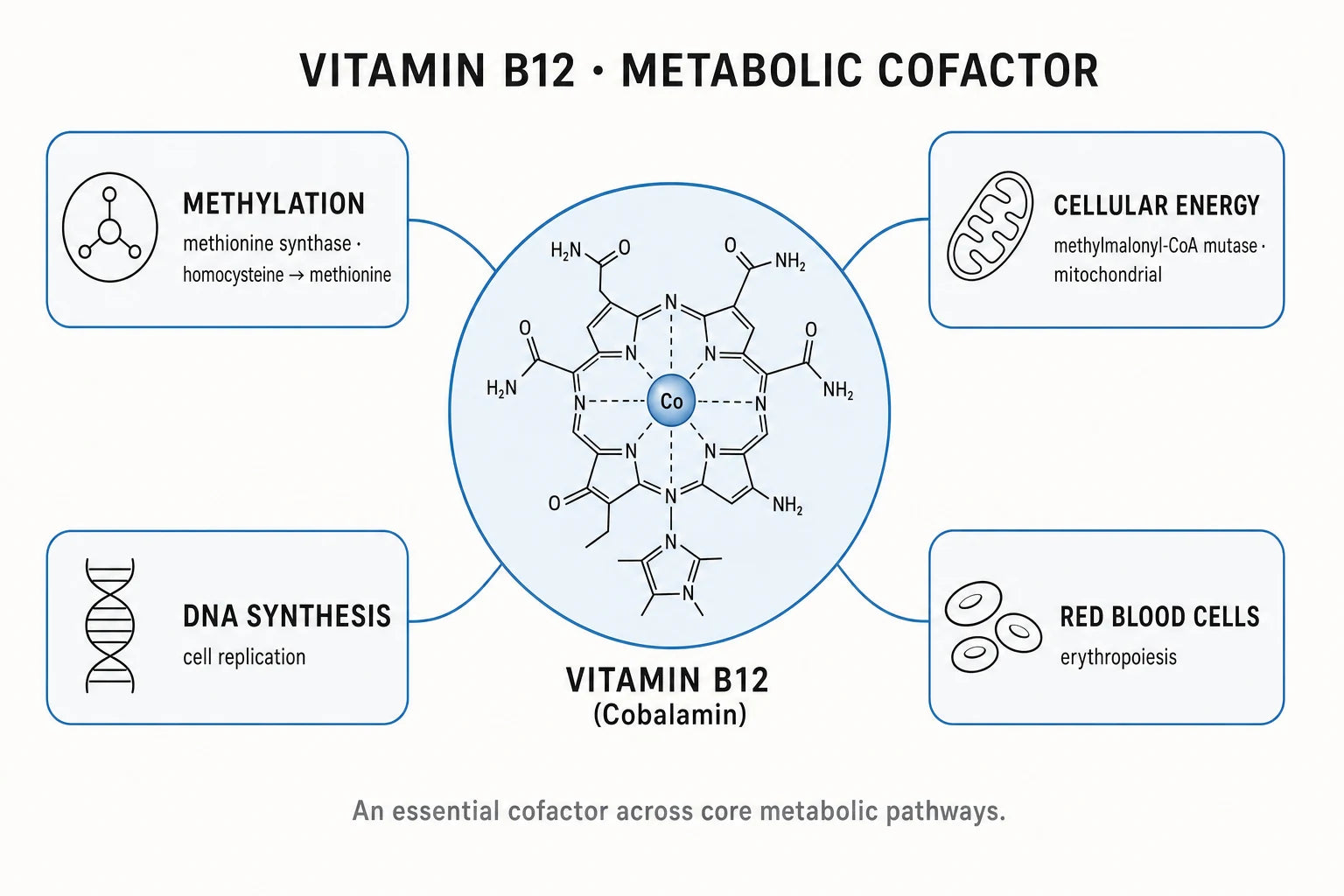
Vitamin B12 (cyanocobalamin) is a water-soluble cofactor at the centre of cellular energy metabolism, the methylation cycle, DNA synthesis and red-blood-cell formation — one of the most fundamental molecules in metabolic research[1].
Biochemically it serves two enzymes: methionine synthase, which remethylates homocysteine to methionine and regenerates the cell’s methyl-donor pool, and methylmalonyl-CoA mutase in mitochondrial energy metabolism[1][2].
Because B12 status governs homocysteine, it features in cognition research: in the randomized, placebo-controlled VITACOG trial, homocysteine-lowering B vitamins (including B12) slowed the rate of brain atrophy in older adults with mild cognitive impairment — an effect concentrated in those with elevated baseline homocysteine[3].
Supplied as a lyophilized powder for reconstitution. Figures above summarize published biochemical and clinical research on the vitamin B12 molecule and are provided as scientific reference for laboratory research only.
Couldn't load pickup availability
Need reconstitution solution? Don’t forget to add Bacteriostatic Water before checkout.


Essential Metabolic Cofactor
The Foundation for Stable Metabolic Research Environments
Vitamin B12 (Cyanocobalamin) is a water-soluble essential cofactor widely used in peptide research settings to ensure optimal metabolic conditions. As a key player in cellular energy production, red blood cell formation, and methylation pathways, B12 provides the stable metabolic foundation that allows researchers to accurately assess peptide effects without confounding variables.
- Essential cofactor for cellular energy metabolism
- Supports red blood cell formation and oxygen transport
- Critical role in methylation and homocysteine pathways
- Stable, easy to handle, minimal interference with peptides
- Provided as lyophilized powder for maximum stability
Cellular Energy & Methylation
How B12 Supports Metabolic Research Models
Vitamin B12 acts as an essential cofactor in multiple enzymatic reactions critical to cellular function. It plays a central role in ATP production, mitochondrial function, and the methylation cycle (homocysteine conversion). In research settings, maintaining adequate B12 levels ensures that metabolic variables remain stable — allowing cleaner data when studying peptide effects on energy, recovery, or metabolic markers.
- Cofactor for ATP production and mitochondrial function
- Essential for methylation cycle (homocysteine pathway)
- Supports DNA synthesis and cellular replication
- Maintains stable metabolic baseline in research models
- Eliminates "metabolic bias" in peptide studies

Research Applications
Complementary Studies with Metabolic and Regenerative Peptides
In peptide research, Vitamin B12 is frequently studied alongside compounds where cellular energy and metabolic stability are critical variables. It enables researchers to maintain optimal conditions when investigating GLP-1/GIP agonists, growth hormone secretagogues, and tissue repair peptides — ensuring that energy-related markers reflect peptide effects rather than cofactor deficiency.
- Metabolic peptide research (Tirzepatide, Semaglutide, Retatrutide)
- GH secretagogue studies (GHRP, Ipamorelin, CJC-1295)
- Tissue repair and recovery modeling (BPC-157, TB-500)
- Lipolysis and energy expenditure research
- Fatigue and cellular recovery studies
- Baseline calibration for multi-day research protocols

The Science Behind Metabolic Stability: Why B12 Matters in Peptide Research
Vitamin B12 (Cyanocobalamin) serves a unique role in peptide research — not as a primary compound under investigation, but as an essential metabolic cofactor that ensures stable, reproducible experimental conditions. When studying peptides that affect energy metabolism, recovery, or cellular function, B12 helps eliminate confounding variables related to baseline metabolic status.
The science is straightforward. B12 is essential for ATP production (cellular energy), mitochondrial function, red blood cell formation, and the methylation cycle that converts homocysteine to methionine. Deficiency in any of these pathways can introduce metabolic bias — making it difficult to distinguish peptide effects from underlying metabolic dysfunction.
In practice, researchers often include B12 when studying metabolic peptides (Tirzepatide, Semaglutide, Retatrutide) to observe how energy modulation influences metabolic response. It's also used alongside GH secretagogues (Ipamorelin, CJC-1295) in models exploring energy and regeneration, and with tissue repair peptides (BPC-157, TB-500) where cellular synthesis demands stable cofactor availability.
B12 is favored in research settings because it's stable, easy to handle, and interferes minimally with most peptide pathways. It provides a reliable way to calibrate protocols, maintain consistent conditions over multi-day studies, and ensure that observed effects reflect the compounds under investigation — not underlying metabolic variability.
For research use only. Not for human consumption.
Scientific Literature
- Banerjee R, Gouda H, Pillay S. Redox-Linked Coordination Chemistry Directs Vitamin B12 Trafficking. Acc Chem Res. 2021;54(8):2003-2013.
- Green R, Miller JW. Vitamin B12 deficiency. Vitam Horm. 2022;119:405-439.
- Green R, Allen LH, Bjorke-Monsen AL, et al. Vitamin B12 deficiency. Nat Rev Dis Primers. 2017;3:17040.
- Kim HI, Hyung WJ, Song KJ, et al. Oral vitamin B12 replacement: an effective treatment for vitamin B12 deficiency after total gastrectomy in gastric cancer patients. Ann Surg Oncol. 2011;18(13):3711-3717.
- Larvie DY, Guitron Leal CE, Venkatramanan S, et al. Vitamin B12 supplementation for growth, development, and cognition in children. Cochrane Database Syst Rev. 2026;6(6):CD015264.
Packaged with care, shipped fast.
We’re a passionate team obsessed with quality, not margins.
- Company
- Price
- Purity
- Quantity
- Shipping
-

B12 – 10mg
-
Prime
Lab PeptidesTypical
Competitor -
$65.00$115.00
- ≥99%95%
- 10mg10mg
- Free 2-Day Shipping3-10 Business Day
-


