


Categories
Recent Articles
-
What Research Says Regarding BPC 157 Healing Effects on the Gut and Inflammation?
213 days ago
This blog explores how BPC 157 functions in controlled research models. It summarizes key mechanisms...
-
What Evidence Shows TB-500 Effectiveness in Tendon and Ligament Repair Post-Injury?
213 days ago
This blog examines current preclinical evidence on TB-500 and its role in tendon and ligament...
-
Are Clinical Trials Showing Grow-H Boosts Muscle Recovery And Performance?
213 days ago
This research-focused blog examines how Grow-H influences muscle-recovery biomarkers, mechanistic pathways, and statistical outcomes in...
All product descriptions and articles provided on this website are intended strictly for informational and educational purposes. Our products are designed exclusively for in-vitro research (i.e., experiments conducted outside of a living organism, typically in glassware such as test tubes or petri dishes). These compounds are not approved by the FDA for use in humans or animals. They are not medications, nor are they intended to diagnose, treat, prevent, or cure any disease or medical condition. Any bodily administration-human or animal-is strictly prohibited by law. Our products are not for human consumption under any circumstances.

What Research Says Regarding BPC 157 Healing Effects on the Gut and Inflammation?
This blog explores how BPC 157 functions in controlled research models. It summarizes key mechanisms related to gut integrity, inflammatory pathways, and experimental administration routes. Moreover, it highlights relevant preclinical findings that guide ongoing scientific inquiry. Researchers can use these insights to better understand the peptide’s evolving role in laboratory-based investigations.

What Evidence Shows TB-500 Effectiveness in Tendon and Ligament Repair Post-Injury?
This blog examines current preclinical evidence on TB-500 and its role in tendon and ligament research. It highlights cellular pathways, comparative peptide insights, and key data gaps in scientific literature. Moreover, it explains how researchers interpret experimental findings responsibly. Overall, the article provides a clear, research-focused overview without implying human therapeutic use.

Are Clinical Trials Showing Grow-H Boosts Muscle Recovery And Performance?
This research-focused blog examines how Grow-H influences muscle-recovery biomarkers, mechanistic pathways, and statistical outcomes in controlled experimental settings. It highlights evidence from university-led trials and explains key variables shaping data interpretation. Moreover, it outlines future study designs that can strengthen reliability. This excerpt supports researchers seeking precise, neutral, and scientifically grounded peptide insights.

Does Scientific Evidence Support BPC-157 as a Long-Term Tendonitis Therapy?
This blog explores the scientific evidence supporting BPC 157 in tendon regeneration and its impact on cellular and molecular pathways. It discusses findings from leading university studies, emphasizing research-driven insights over therapeutic claims. Moreover, it highlights how Prime Lab Peptides supports researchers by providing high-purity, consistent, and reliable peptides essential for advancing reproducible experimental outcomes.

What Evidence Supports KLOW Peptides in Angiogenesis and Tissue Repair?
This blog examines the scientific basis of KLOW peptides, concentrating on their molecular mechanisms in angiogenesis, inflammation regulation, and tissue regeneration. It draws on peer-reviewed research from leading universities to present accurate, evidence-based insights. Written exclusively for a research audience, it emphasizes controlled laboratory applications. Prime Lab Peptides supports this work by providing high-purity, research-grade materials for advanced experimental studies.
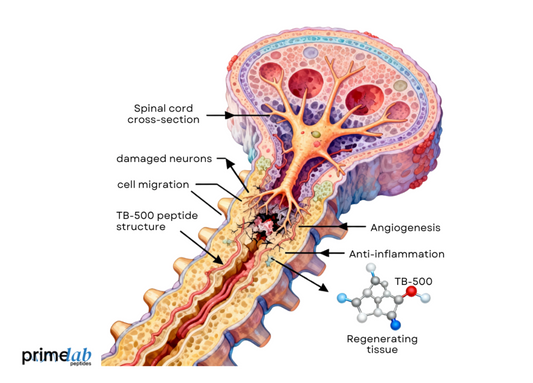
Can TB-500 Support Regeneration in Spinal Cord Injuries?
TB-500 shows great promise in promoting spinal cord regeneration and neural recovery. It works by enhancing cell repair, reducing inflammation, and supporting tissue remodeling for better healing outcomes. Researchers worldwide are exploring its powerful regenerative potential. At Prime Lab Peptide, we provide high-quality, research-grade TB-500 for advanced studies. Our precision and innovation empower scientists to achieve groundbreaking results in regenerative medicine.