
All product descriptions and articles provided on this website are intended strictly for informational and educational purposes. Our products are designed exclusively for in-vitro research (i.e., experiments conducted outside of a living organism, typically in glassware such as test tubes or petri dishes). These compounds are not approved by the FDA for use in humans or animals. They are not medications, nor are they intended to diagnose, treat, prevent, or cure any disease or medical condition. Any bodily administration-human or animal-is strictly prohibited by law. Our products are not for human consumption under any circumstances.

Short answer: the evidence that GHK-Cu affects scars is laboratory evidence, not clinical evidence. In cultured human dermal fibroblasts — including cells taken from keloids — copper tripeptide lowered secretion of TGF-β1, the signal that drives excessive scar formation (McCormack 2001; Gruchlik 2014). That is a mechanism, not a scar that faded.
Human scar data stays thin, and it is topical. A 2024 review of topical GHK reports a surprising absence of clinical studies on the cosmetic complexes (Mortazavi 2024), and the most recent scar study tested a multi-ingredient gel, open-label and without a control group, so its numbers cannot be credited to GHK-Cu alone. There is no comparable body of work for an injectable route.
Delivery is the part most pages skip. In an in vitro human skin model, almost no GHK-Cu crossed intact skin; permeation happened only after microneedle pre-treatment (Li 2015). That is why copper-peptide serums are usually paired with microneedling or laser, and why the route matters more than the percentage on the label.
What the published work does support is cellular, and it is the subject of the sections below: GHK-Cu shifts fibroblast gene expression, raises decorin (which organises collagen fibrils), increases type I and III collagen without raising TGF-β, limits the persistence of myofibroblasts — the cells behind raised, contracted scars — and restores growth-factor output in irradiated fibroblasts. Each section states which model the finding comes from.
How Does GHK-Cu Change Scar-Building Fibroblasts?
At the molecular level, the structural and matrix-level effects observed in repair models are driven by transcriptional reprogramming within dermal fibroblasts. GHK-Cu alters gene expression patterns that favor a regenerative cellular state rather than a purely synthetic output.
Research demonstrates [2] that the tripeptide-copper complex interacts with fibroblast surface signaling pathways to regulate genes involved in proliferation, cellular maintenance, and stress resistance. Specifically, GHK-Cu suppresses transcriptional programs associated with cellular senescence while enhancing expression of genes linked to DNA repair, proteostasis, and metabolic resilience. This shift enables fibroblasts to sustain functional activity under experimental stress conditions.
In addition, GHK-Cu increases mRNA expression of multiple growth-associated factors and modulates key intracellular pathways, including:
-
Activation of antioxidant genes: Significant upregulation of SOD1 and other protective enzymes to mitigate oxidative stress.
-
Cell cycle regulation: Modulation of cyclin-dependent kinases to promote controlled mitotic activity in quiescent cell populations.
- Expression of decorin: Increased synthesis of this small leucine-rich proteoglycan, which is essential for organized collagen fibrillogenesis.
Does GHK-Cu Reduce Scarring? The Collagen Evidence
GHK-Cu plays a central role in extracellular matrix synthesis by enhancing fibroblast-mediated production of key structural components, particularly collagen and glycosaminoglycans, within controlled experimental models. A study published in NCBI [3], administration of GHK-Cu in an in vivo wound chamber model produced a dose-dependent increase in total protein, collagen content, and glycosaminoglycan accumulation relative to untreated controls.
Importantly, the study reported elevated mRNA levels for Type I and Type III collagen, indicating that GHK-Cu directly stimulates collagen gene expression during matrix formation. These findings establish the peptide as an active regulator of ECM biosynthesis rather than a passive structural factor.
The observed increase in extracellular matrix components occurred without concomitant upregulation of transforming growth factor-β (TGF-β), suggesting that GHK-Cu promotes matrix synthesis through alternative regulatory pathways. By selectively enhancing collagen and glycosaminoglycan production, GHK-Cu supports the development of a structurally organized extracellular scaffold that resembles native tissue architecture in experimental repair environments.
Raised and Contracted Scars: GHK and Myofibroblasts
GHK influences myofibroblast function by regulating the persistence and resolution of fibrotic activity rather than initiating myofibroblast differentiation. It acts downstream of differentiation by shaping fibroblast–matrix interactions, limiting prolonged myofibroblast survival, and supporting the transition from contractile remodeling to tissue maturation. Through these effects, GHK helps prevent excessive tissue stiffening while allowing physiologic repair to proceed.
At the cellular level, GHK influences key processes that determine myofibroblast behavior during repair:
-
Limits myofibroblast persistence: GHK is associated with pathways that favor myofibroblast apoptosis or deactivation during later repair phases.
-
Regulates matrix–cell tension: By improving extracellular matrix organization, GHK reduces the mechanical cues that sustain myofibroblast contractility.
-
Modulates fibroblast aging programs: GHK modulates senescence-linked signaling, influencing whether fibroblasts remain in a fibrotic state.
- Supports repair resolution: These combined effects shift tissue remodeling away from chronic contraction toward structural stabilization.
Evidence shows [4] that GHK regulates fibrotic remodeling by influencing myofibroblast survival, senescence, and regenerative signaling instead of directly suppressing α-SMA expression or TGF-β pathways. The peptide operates at the level of remodeling resolution, shaping how fibroblasts and myofibroblasts interact with the extracellular matrix. This mechanism positions GHK as a regulator of fibrosis progression and resolution rather than a direct inhibitor of myofibroblast differentiation markers.

GHK-Cu and Radiation-Damaged Skin: Study Results
Yes, an investigative study published in PubMed Central [5] examined the effects of copper tripeptides on radiation-damaged fibroblasts. The study found that GHK-Cu treatment resulted in a statistically significant recovery of cellular function, allowing irradiated cells to produce growth factors at levels comparable to healthy, non-irradiated control groups. This suggests that the peptide provides a protective mechanism that supports cellular resilience under extreme experimental conditions.
Moreover, the restoration of these damaged populations is characterized by a return to normal patterns of protein synthesis. Additionally, the research indicates that the presence of GHK-Cu mitigates the production of pro-inflammatory cytokines that usually follow cellular injury. Consequently, the peptide creates a more stable environment for fibroblast-led matrix assembly, even when the initial cell population has been significantly impaired by external variables.
Advance Your GHK-Based Fibrosis and Remodeling Research with Reliable Peptide Support
Research focused on GHK-mediated fibrotic remodeling and myofibroblast regulation requires highly consistent peptide quality and well-documented specifications. Variability in peptide purity, incomplete analytical data, or unreliable sourcing can compromise experimental interpretation, slow progress, and limit reproducibility in fibrosis and repair studies.
At Prime Lab Peptides, we support advanced peptide research by supplying verified, research-grade GHK peptides produced under strict quality control standards. Comprehensive documentation and batch consistency help ensure dependable experimental outcomes across cellular and molecular research models. To request specifications or discuss your research requirements, contact us to learn how we can support your ongoing GHK-focused investigations.
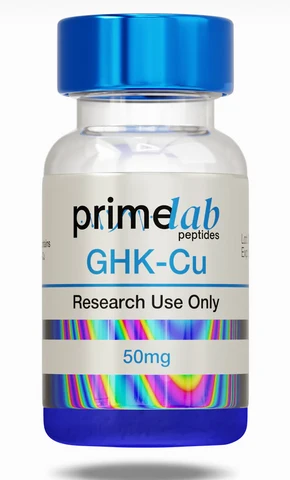
GHK-Cu reference materials
The compounds discussed on this page, supplied by Prime Lab Peptides for laboratory research use only:
- GHK-Cu – 50mg — the tripeptide-copper complex used in the fibroblast and matrix studies cited above.
- GHK-Cu – 100mg — same compound, larger vial for extended dose-response work.
- Glow – 70mg — a blend containing GHK-Cu, for comparisons against the single peptide.
What Is GHK-Cu, and What Is the Copper Actually For?
GHK-Cu is a three-residue peptide — glycine, histidine, lysine — carrying a copper(II) ion. The peptide itself was isolated from human plasma in 1973, when Pickart and Thaler described a serum fraction that kept aged liver cells functioning in culture (Pickart and Thaler, 1973). The copper is not an additive bolted on afterwards: the histidine imidazole, the free amino terminus and a backbone nitrogen form a high-affinity chelation site, which is why the literature treats GHK as a copper-transport peptide rather than a peptide that happens to have a metal nearby.
That distinction matters for the fibroblast sections on this page. Copper is a cofactor for lysyl oxidase, the enzyme that cross-links collagen and elastin, so a molecule that carries copper into a repair site acts on matrix chemistry from a different angle than a growth factor does.
Two figures circulate constantly in secondary write-ups, and both deserve a label:
- Plasma GHK declines with age — commonly quoted as roughly 200 ng/mL in the twenties falling to about 80 ng/mL by 60. That number travels through review papers written by the peptide's original describer rather than from a dedicated population study, so it is best read as an often-repeated estimate, not a measured cohort value.
- GHK modulates "at least 4,000 human genes" — this comes from comparing GHK's expression signature against the Broad Institute Connectivity Map database (Pickart et al., 2015; Pickart and Margolina, 2018). It is a database signature comparison, not 4,000 validated repair experiments, and both papers are reviews authored by parties commercially involved with the peptide.
Everything in the sections that follow is downstream of those two properties: a copper carrier, and a broad transcriptional signature observed in cell and animal systems.
Does GHK-Cu Reduce Inflammation? What the Animal Models Show
The anti-inflammatory data are consistent across models, and almost none of them involve skin. What exists is rodent and cultured-macrophage work in the lung and the gut — worth reading here precisely because it runs through the same signalling axes that decide scar outcome in dermis.
In a lipopolysaccharide model of acute lung injury, GHK-Cu lowered reactive oxygen species and raised superoxide dismutase activity in RAW 264.7 macrophages, reduced TNF-α and IL-6, and did so through suppression of NF-κB p65 and p38 MAPK; treated mice showed less inflammatory infiltration of the lung parenchyma (Park et al., 2016).
In dextran-sulfate-sodium colitis in BALB/c mice, GHK-Cu lowered the disease activity index, limited colon shortening, preserved goblet cell numbers, and suppressed TNF-α, IL-6 and IL-1β. In a co-culture of colonic epithelial cells with peritoneal macrophages it restored the tight-junction proteins ZO-1 and occludin, and the authors traced the effect to the SIRT1/STAT3 axis: silencing STAT3 abolished the epithelial-healing effect (Mao et al., 2025).
In bleomycin-induced pulmonary fibrosis, GHK alone (Zhou et al., 2017) and the copper complex (Ma et al., 2019) both reduced TNF-α, IL-6 and myeloperoxidase activity, corrected the MMP-9/TIMP-1 imbalance, and dampened TGF-β1/Smad2/3 signalling with partial blockade of epithelial-to-mesenchymal transition.
Two limits belong with all of it. These were injected exposures in animals, not topical skin exposure, and there is no human inflammation dataset for GHK-Cu. The reason the work sits on this page is pathway overlap: TGF-β1/Smad signalling and the MMP/TIMP balance are the same levers the dermal fibroblast studies above describe, observed in a different organ.
Molecular Docking: Which GHK-Cu Target Has Actually Been Modelled?
One target. As of this writing, a single published study indexed in PubMed applies molecular docking to GHK-Cu, and that target is SIRT1.
Mao and colleagues paired network pharmacology with docking inside their colitis study (Mao et al., 2025). The network step returned five candidate targets — REN, LNPEP, HLA-A, OXTR and SIRT1 — and SIRT1 was carried forward. The docked complex returned a binding energy of −8.75 kcal/mol, with contacts at GLU-230 and ASN-226. The prediction was then tested in the same paper: SIRT1 protein rose, phosphorylated STAT3 fell, and siRNA knockdown of STAT3 removed the healing effect on epithelial cells.
It is worth being precise about what docking adds. It produces a computed pose and a score. A value of −8.75 kcal/mol describes a favourable simulated fit; it is not a measured dissociation constant, it does not establish that the complex forms inside a cell, and it says nothing about occupancy at any realistic concentration. Its value in this case is that it generated a hypothesis the same authors then knocked down — which is the only reason it is worth citing.
Two docking claims that do not hold up
Secondary sources frequently state that docking confirms GHK-Cu coordination with Cu/Zn-superoxide dismutase at HIS-46 and HIS-120, and that it occupies an allosteric site on p38 MAP kinase. Neither traces back to a published GHK docking study. The allosteric p38 site is real, but it was described for an unrelated inhibitor chemotype (Pargellis et al., 2002), not for GHK-Cu. The peptide's effect on p38 is documented functionally — reduced phosphorylation in macrophages (Park et al., 2016) — not structurally.
Chronic Non-Healing Wounds: What the Human and Animal Record Shows
One controlled human trial of GHK-Cu on chronic wounds exists, it was published in 1994, and nothing since has replicated it.
That trial (Mulder et al., 1994) was a multicentre, randomised, evaluator-blinded, placebo-controlled study in diabetic neuropathic ulcers. A topical GHK-Cu gel was layered on top of a standardised care protocol — sharp debridement at entry, pressure-relieving footwear, patient education — and compared against the vehicle. The reported outcomes:
- Median area closure of plantar ulcers of 98.5% with the peptide gel versus 60.8% with vehicle (p < 0.05).
- In ulcers larger than 100 mm² at entry, median closure of 89.2% versus −10.3% for vehicle (p < 0.01) — the larger vehicle-treated ulcers grew.
- Ulcer infection incidence of 7% versus 34% (p < 0.05) where treatment began immediately after debridement.
Those are the strongest human numbers anywhere in the GHK literature. They are also three decades old, from a single trial, on a product that never became standard care, with no modern replication. An unreplicated trial is a reason to test, not a settled result.
Work since has been animal and materials science, and it has shifted toward delivery. A self-assembling RADA16 nanofibre functionalised with GHK to chelate copper accelerated wound closure, collagen deposition and tissue remodelling in both healthy and diabetic mice, with raised eNOS and CD31 in treated tissue (Yang et al., 2022). Both markers are endothelial: the mechanism credited there is new vessel formation, not fibroblast output.
That is the part a purely fibroblast-centred reading misses. Chronic wounds stall for vascular and inflammatory reasons as much as matrix ones, and the angiogenic arm of GHK's profile is where the chronic-wound models place their emphasis.
Is Anyone Testing GHK-Cu on Human Wounds Right Now?
Yes — one Phase 2 trial is recruiting, and no results have been posted.
CuHeal (NCT07437586), sponsored by Hudson Biotech, opened in February 2026. It is randomised, double-blind and vehicle-controlled, with a split-wound design: 60 healthy adults aged 18 to 55 receive two 5 mm punch-biopsy wounds on the non-dominant upper arm, randomised 1:1 so one wound receives a topical GHK-Cu gel and the other a matching vehicle under identical dressings. The primary endpoint is time to complete re-epithelialisation, read by blinded assessment and standardised photography over 21 days. Primary completion is projected for February 2027, with one listed site.
Two details make this directly relevant to the scar question this page opens with. Scar quality on the POSAS scale at 12 weeks is a listed secondary endpoint, which would be the first prospective, vehicle-controlled scar measurement in the GHK literature. And the split-wound design places peptide and vehicle in the same person, on the same limb, under the same dressing — removing the between-subject variability that has left every open-label copper-peptide scar report uninterpretable.
The design also draws the boundaries of what it can answer. The wounds are acute, standardised and 5 mm; participants are healthy and non-smoking, with diabetes, impaired healing and a history of keloid or hypertrophic scarring all excluded. Whatever it reports will speak to normal acute healing in healthy skin, not to chronic ulcers and not to established scars. Until results are posted, the human wound-closure question remains open.
FAQs
Does GHK-Cu exhibit dose-dependent effects in fibroblast research models?
Yes. Experimental studies demonstrate that GHK-Cu activity is dose-dependent, with optimal concentrations enhancing fibroblast function and matrix synthesis. Excessive concentrations may reduce specificity, emphasizing the importance of controlled dosing when evaluating collagen production, gene expression, and remodeling outcomes in vitro and in vivo.
Is GHK-Cu active in both aged and non-aged fibroblast populations?
GHK-Cu shows biological activity in both aged and non-aged fibroblast populations. Evidence suggests its effects are more pronounced in aged or stressed cells, where it supports restoration of regenerative signaling, improved matrix organization, and normalization of fibroblast functional capacity.
Does GHK-Cu directly bind DNA to regulate gene expression?
No. GHK-Cu does not directly bind DNA. Its effects on gene expression occur indirectly by modulating cell-surface signaling pathways, redox balance, and transcriptional regulators that influence fibroblast proliferation, stress response, and extracellular matrix–related gene networks.
How stable is GHK-Cu under standard laboratory storage conditions?
GHK-Cu is chemically stable when stored under recommended laboratory conditions, typically at low temperatures and in a dry, light-protected environment. Proper storage preserves copper coordination and peptide integrity, ensuring reproducible biological activity across experimental applications.
Can GHK-Cu be used in combination with other growth factors in research models?
Yes. GHK-Cu has been evaluated alongside growth factors in experimental settings. Its role appears supportive rather than competitive, often enhancing cellular responsiveness and matrix organization. However, combinatorial effects depend on concentration, timing, and the specific experimental model used.
Is GHK-Cu primarily a signaling molecule or a structural component in tissue repair models?
GHK-Cu functions primarily as a signaling molecule rather than a structural matrix component. It regulates fibroblast behavior, gene expression, and remodeling dynamics, indirectly influencing collagen deposition and tissue architecture without becoming a physical part of the extracellular matrix.
Reference


