
All product descriptions and articles provided on this website are intended strictly for informational and educational purposes. Our products are designed exclusively for in-vitro research (i.e., experiments conducted outside of a living organism, typically in glassware such as test tubes or petri dishes). These compounds are not approved by the FDA for use in humans or animals. They are not medications, nor are they intended to diagnose, treat, prevent, or cure any disease or medical condition. Any bodily administration-human or animal-is strictly prohibited by law. Our products are not for human consumption under any circumstances.

Short answer: nearly all usable GHK-Cu skin evidence comes from topical copper-peptide formulations tested on human skin, alongside a much larger body of in vitro and animal work on collagen, fibroblasts and wound repair. There is essentially no published human skin data for GHK-Cu given by injection.
That split matters more than any single benefit claim, and it is the part most GHK-Cu summaries skip. The human trials that exist tested creams and serums applied to the skin. The mechanism quoted alongside them — collagen and elastin synthesis, glycosaminoglycans, copper-dependent enzymes, wound-healing gene expression — comes mostly from cell culture and rodent models. Both are real evidence; they answer different questions.
Below, each claim is sorted by where it actually comes from: human topical, animal, or in vitro. Injectable GHK-Cu is not an FDA-approved product, sits in a different risk category from a cosmetic cream, and is supplied here for research use only — the human-evidence section states plainly what has and has not been measured.
How Does GHK-Cu Clinically Impact Wrinkle Reduction and Skin Elasticity?
GHK-Cu impacts wrinkle-related and elasticity-focused research by supporting pathways involved in structural regeneration. Studies show[2] that it improves tissue remodelling and stimulates collagen and decorin production. Additionally, researchers observe measurable gains in dermal quality and elasticity markers across controlled experimental models.
Several key research observations highlight these effects:
- GHK-Cu studies reported increased dermal thickness and hydration.
- Trials showed stronger elasticity restoration than common antioxidants.
- Research found enhanced collagen organization in laboratory models.
Because of these findings, GHK-Cu remains a central molecule in elasticity and wrinkle-related investigations. Its documented effects arise from peptide-driven interactions with extracellular matrix components. Therefore, researchers continue exploring its role in structural skin studies.
What Molecular Mechanisms Underlie GHK-Cu’s Skin Regeneration?
GHK-Cu supports skin-regeneration research by interacting with copper-dependent pathways that influence cellular activity. Studies show that it affects structural, genetic, and enzymatic processes. Moreover, these mechanisms work together to regulate skin-related regenerative responses.
Here are the core mechanisms researchers consistently highlight in studies:
- Fibroblast Activation: A Study from the MDPI[3] paper states that GHK-Cu restores the functional activity of irradiated fibroblasts to levels comparable to intact cells. It supports faster fibroblast growth in controlled models. Additionally, it enhances the production of key growth factors such as bFGF and VEGF, reinforcing its relevance in regeneration-focused research.
- Gene Expression Influence: The peptide modulates genes linked to antioxidant activity and extracellular matrix stability, helping researchers understand how molecular balance is maintained during regeneration processes and tissue-focused laboratory investigations.
- MMP–TIMP Regulation: GHK-Cu affects metalloproteinases and their inhibitors, which together maintain collagen turnover. This regulation provides insight into how collagen stability is preserved in controlled skin-regeneration research settings.

What Role Does GHK-Cu Play in Collagen Synthesis and Skin Matrix Organization?
GHK-Cu plays a key role in collagen synthesis and matrix organization by influencing pathways that regulate essential structural proteins. According to GHK Peptide as a Natural Modulator of Multiple Cellular Pathways in Skin Regeneration[4], it stimulates collagen, dermatan sulfate, chondroitin sulfate, and the small proteoglycan decorin. It also supports balanced MMP activity, helping preserve matrix stability. Together, these actions highlight their relevance in collagen-focused laboratory studies.
Moreover, GHK-Cu influences multiple components of the skin matrix beyond collagen regulation. Research shows that it supports elastin and glycosaminoglycan levels, which contribute to elasticity and moisture behaviour in controlled studies. These molecules help maintain structural strength across experimental models. The peptide’s involvement in matrix organization provides insight into how overall balance is sustained. Therefore, investigators continue analysing its role in skin-related biochemical pathways.
What Are the Safety Considerations and Long-Term Effects of GHK-Cu Usage?
GHK-Cu’s safety considerations in research primarily involve its interaction with copper-dependent pathways and its concentration-dependent activity. Studies show generally favourable profiles, yet researchers continue examining long-term effects, potential sensitivity, and biochemical responses in controlled laboratory settings.
Below are key safety elements researchers consistently evaluate carefully:
1. Concentration and Copper Balance
Researchers monitor dosage carefully because excessive copper exposure may disrupt cellular equilibrium. Controlled concentrations help maintain physiological relevance, allowing studies to assess activity without triggering unintended copper-related responses or biochemical overload in experimental models.
2. Skin Sensitivity and Irritation
Some subjects in research settings show mild redness or irritation during early exposure. These responses typically resolve quickly, yet investigators record them to understand tolerance patterns and ensure consistency across diverse experimental conditions and peptide-testing environments.
3. Long-Term Observational Gaps
Long-term effects remain under investigation because available studies are still limited in duration. Academic groups are expanding follow-up periods to capture deeper insights into structural, enzymatic, and matrix-related changes linked to extended GHK-Cu exposure.
Advance Your Research With Trusted Peptide Solutions From Prime Lab Peptide
Many researchers face persistent barriers when working with peptide-based models. Limited purity, inconsistent sourcing, variable batch performance, and communication gaps with suppliers often slow experimental progress. These issues make it difficult to maintain reproducibility, meet project timelines, and generate dependable data across extended studies or multi-phase laboratory investigations.
Prime Lab Peptide provides consistent GHK-Cu materials and clear documentation for research needs. Our team supports experimental workflows with reliable communication and transparency. We focus on stable sourcing to strengthen reproducibility across ongoing studies. For project-specific guidance or material inquiries, researchers are welcome to contact us for further assistance today.
Which Copper-Dependent Enzymes Does GHK-Cu Feed?
The enzyme named most often is lysyl oxidase (LOX), and the connection to GHK-Cu is inferred from copper chemistry rather than measured directly in skin. LOX is a copper-dependent amine oxidase: it cross-links lysine residues in newly deposited collagen and elastin, and that cross-linking is what turns freshly synthesised fibres into a mechanically stable dermal matrix. Because GHK binds copper(II) with high affinity and can exchange it with other copper-binding sites, review literature proposes that the peptide behaves as a copper carrier that keeps cuproenzymes such as LOX supplied. The confirmation step is what is missing: a PubMed search returns no study measuring LOX activity or cross-link density in skin before and after GHK-Cu exposure. The mechanism is coherent and unverified at the same time, and it should be read that way.
Two other copper enzymes recur in the same discussion:
- Cu/Zn superoxide dismutase (SOD1) — copper sits in its catalytic site, and animal models report higher SOD activity in GHK-Cu-treated tissue. Worth noting: an early study by Miller and colleagues (1990) found that GHK-Cu itself showed no significant SOD-like or ceruloplasmin-like activity. Any rise in SOD activity is therefore a cellular response, not the peptide acting as a substitute enzyme.
- Tyrosinase — another copper-cofactor enzyme, central to melanin synthesis and of interest for pigmentation and barrier recovery after injury. No skin study has shown that GHK-Cu changes tyrosinase output in human tissue.
The practical distinction for anyone reading collagen data: more collagen produced is a fibroblast and transcription-level observation, and it is documented. Collagen better cross-linked is an enzyme-level claim, and it remains inferred. The copper-carrier layer is what separates GHK-Cu from peptides that carry no metal — which is exactly why it deserves stating as a hypothesis rather than a result.
What Does GHK-Cu Do to Inflammation and Oxidative Stress — and Where Does That Data Come From?
GHK-Cu shows measurable anti-inflammatory and antioxidant activity in animal and cell models, but most of that mechanistic work was done in lung tissue and macrophages, not skin. That provenance matters when the findings are carried over to dermal research.
In a mouse model of lipopolysaccharide-induced acute lung injury and in RAW 264.7 macrophages, Park and colleagues (2016) reported reduced reactive oxygen species, increased superoxide dismutase activity, and lower TNF-α and IL-6 production, attributed to suppression of NF-κB p65 and p38 MAPK signalling. In a separate cigarette-smoke emphysema model, Zhang and colleagues (2022) observed lower IL-1β and TNF-α in bronchoalveolar lavage, restored glutathione and total antioxidant capacity, reduced NF-κB expression alongside raised Nrf2, and a partly corrected MMP-9/TIMP-1 imbalance. Both are animal and in vitro studies.
The antioxidant side has a mechanistic wrinkle worth keeping. Miller and colleagues (1990) found that GHK-Cu inhibits ferritin-dependent lipid peroxidation, apparently by blocking iron release from ferritin rather than by scavenging radicals itself — the same study that found no meaningful SOD-like activity for the complex. In other words, the effect described looks upstream: limiting the catalytic iron that drives peroxidation, not neutralising the products afterwards.
The overlap with skin biology is real but indirect. NF-κB signalling, the MMP/TIMP balance and redox control all operate in dermal repair, and they are the same axes the hub discusses under matrix regulation. What has not been done is the equivalent cutaneous experiment with the same readouts. Researchers following this thread will find the antioxidant-enzyme and cytoprotective gene work treated in more depth in our review of GHK-Cu and oxidative stress reduction.
How Strong Is the Human Skin Evidence for GHK-Cu?
The mechanistic and preclinical evidence is considerably stronger than the human dermatology evidence, and the gap is wide enough that it changes how the collagen findings should be read.
Randomised human data indexed on PubMed is scarce. The retrievable controlled trial is Miller and colleagues (2006, Archives of Facial Plastic Surgery): thirteen patients randomised after CO2 laser resurfacing to a post-treatment regimen with or without a GHK-Cu skincare product. Computer analysis and blinded evaluators found no significant difference in erythema resolution, wrinkles or overall skin quality between groups; only the patient questionnaire showed higher satisfaction in the GHK-Cu arm (P = .04). A thirteen-patient study in one surgical context is not evidence of absence, but it is the level of published human evidence that currently exists.
Several figures circulating in secondary sources do not survive checking. A frequently quoted percentage increase in subdermal echogenic density traces back to a press release rather than a peer-reviewed publication, and the wrinkle-depth percentages come from cosmetic-industry reports with no retrievable primary paper. Neither is restated here.
Delivery is a second open question. Whether topically applied GHK-Cu reaches viable dermis has been examined mainly in artificial systems — Franz diffusion cells with liposome membranes modelling stratum-corneum lipids (Mazurowska & Mojski, 2008) — and a 2025 methodological paper in Molecules frames the measurement of skin permeation for liposome-encapsulated GHK-Cu as still unsettled.
A workable hierarchy for study design: fibroblast responses in culture are robust and reproducible; rodent wound-closure and histology findings are consistent across models; human skin outcomes are thin and almost entirely topical. The cellular and matrix-remodelling side of that evidence base is examined further in our review of GHK-Cu and fibroblast phenotype in experimental repair models.
GHK-Cu Research Material Discussed Here
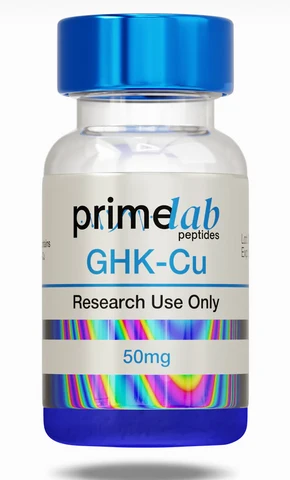
- GHK-Cu – 50mg — single vial of the copper tripeptide discussed throughout this page.
- GHK-Cu – 100mg — larger vial, for multi-arm or repeated-assay protocols.
- Glow – 70mg — blend of GHK-Cu with BPC-157 and TB-500, for protocols comparing a combination against GHK-Cu alone.
FAQs
How Is GHK-Cu Stored for Stability?
GHK-Cu is stored under controlled, low-temperature conditions to protect structural integrity. These conditions support consistent performance across research cycles. Additionally, proper handling prevents degradation that might interfere with experimental results.
What Assays Commonly Evaluate GHK-Cu Activity?
Researchers commonly evaluate GHK-Cu using gene-expression panels and matrix-related biochemical assays. These methods capture their influence on collagen pathways. Additionally, they provide measurable data for comparing peptide performance across experimental conditions.
How Do Researchers Measure Collagen Changes?
Researchers measure collagen changes through histological staining and molecular protein-quantification techniques. These tools show shifts in extracellular-matrix organization. Furthermore, controlled trials help validate results across multiple model types.
What Variables Impact GHK-Cu Experimental Outcomes?
GHK-Cu outcomes depend on concentration, exposure duration, and model type. These variables shape biochemical responses. Consequently, researchers adjust each parameter carefully to maintain reproducibility across studies.
References


