
All product descriptions and articles provided on this website are intended strictly for informational and educational purposes. Our products are designed exclusively for in-vitro research (i.e., experiments conducted outside of a living organism, typically in glassware such as test tubes or petri dishes). These compounds are not approved by the FDA for use in humans or animals. They are not medications, nor are they intended to diagnose, treat, prevent, or cure any disease or medical condition. Any bodily administration-human or animal-is strictly prohibited by law. Our products are not for human consumption under any circumstances.

Short answer: about two-thirds of the weight came back. In the STEP 1 trial extension, 327 participants were followed for one year after semaglutide and the lifestyle programme were both stopped at week 68. Mean weight loss was 17.3% at week 68; by week 120 the semaglutide group had regained 11.6 percentage points of it, ending 5.6% below baseline against 0.1% for placebo (Wilding et al., 2022).
The cardiometabolic markers moved the same way. The improvements recorded between week 0 and week 68 reverted towards baseline by week 120 for most measures. Whatever the mechanism, none of it held once exposure ended.
Three caveats travel with that number. The extension was exploratory and covered a subset of sites, not the full 1,961-participant trial. Treatment and lifestyle intervention were withdrawn together, so their contributions cannot be separated. And a one-year off-treatment window says nothing beyond that point — no trial designed specifically to test withdrawal has been published.
On treatment, the picture is different: in SELECT, the weight gap versus placebo was still −10.2% against −1.5% at week 208. This page covers both windows, what the multi-year trials report on tolerability, and where the liver evidence is weakest.
How do semaglutide phase III STEP trials quantify cardiometabolic endpoints?
Semaglutide STEP Phase III trials quantify cardiometabolic endpoints through structured, randomized, placebo-controlled designs that separate weight effects from metabolic changes. This approach allows researchers to isolate vascular and metabolic outcomes. The studies integrate lifestyle interventions alongside drug administration.
Key cardiometabolic outcomes assessed include:
- Waist circumference and systolic/diastolic blood pressure
- Fasting plasma glucose, serum insulin, and HOMA‑IR
- LDL cholesterol, non‑HDL cholesterol, triglycerides, and ASCVD risk scores
These measurements help researchers evaluate effects beyond body weight. Additionally, separating metabolic variables clarifies the influence of semaglutide on cardiometabolic health. Overall, the STEP trials provide detailed, controlled insights into complex obesity-related risk factors.
What cardiometabolic risk markers improve independently of achieved weight loss?
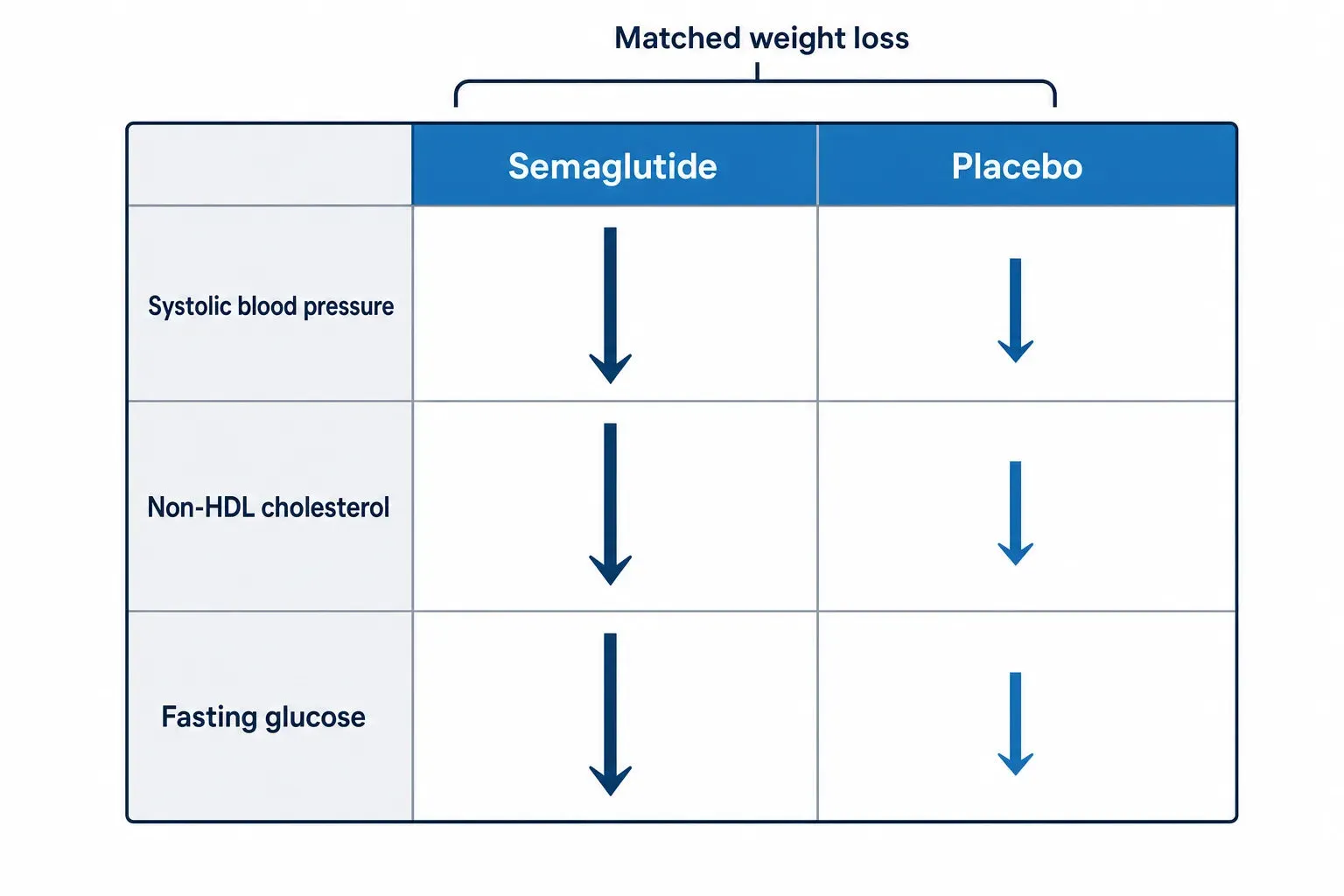
Several cardiometabolic risk markers improve independently of weight loss in semaglutide trials. As reported in PMC[2], these include blood pressure, non-HDL cholesterol, LDL cholesterol, and fasting glucose. Stratified analyses show semaglutide provides additional metabolic benefits beyond reductions in body weight.
Key cardiometabolic improvements occur even when weight loss is modest:
- Systolic blood pressure: Semaglutide lowers systolic blood pressure more than placebo within the same weight-loss categories. This indicates a direct vascular effect that is not solely dependent on body-mass reduction.
- Non-HDL and LDL cholesterol: These lipid markers decrease disproportionately in participants receiving semaglutide compared with placebo. This suggests semaglutide influences cholesterol metabolism beyond weight-mediated mechanisms.
- Fasting glucose: Reductions in fasting glucose are observed even in participants achieving modest 5–<10% weight loss. This demonstrates semaglutide’s ability to modulate glucose regulation independently of changes in adiposity.
How do semaglutide trials characterise effects on vascular and atherosclerotic risk?
Semaglutide obesity trials characterise vascular and atherosclerotic risk using predicted ASCVD scores and blood pressure measurements. In non-diabetic STEP cohorts, these risk assessments are combined with weight and biomarker data to generate integrated cardiometabolic profiles. According to Frontiers in Cardiovascular Medicine[3], the 10-year ASCVD risk is calculated using ACC/AHA pooled cohort equations at baseline and week 68. This approach allows researchers to track transitions between low, borderline, intermediate, and high-risk categories efficiently.
Notably, semaglutide shifts participants toward lower predicted ASCVD risk, while placebo groups often show modest increases. Meanwhile, the SELECT cardiovascular outcomes trial demonstrates a significant reduction in major adverse cardiovascular events among participants with established cardiovascular disease. Evidence from PubMed Central[4] indicates that semaglutide may influence vascular and atherosclerotic risk through risk-factor modification and potential GLP-1–mediated vascular mechanisms.
What translational implications emerge for cardiometabolic risk management strategies?
Translational implications emerge through the capacity to analyse weight-independent cardiometabolic responses that clarify mechanistic pathways in research models. Additionally, semaglutide datasets enable examination of coordinated vascular, metabolic, and inflammatory signals. Moreover, outcome-trial evidence supports linking these mechanistic patterns to long-term cardiometabolic trajectories in experimental contexts.
These findings reveal three key translational implications for research applications:
1. Weight-Independent Effects
Stratified analyses indicate that some cardiometabolic markers shift independently of weight change, enabling researchers to distinguish adiposity-related pathways from direct GLP-1 receptor-mediated signalling and to construct more precise vascular and metabolic models.
2. Multi-Parameter Modelling
Trial protocols that document adjustments in antihypertensive and lipid-modifying therapy create multi-layered datasets, allowing researchers to integrate peptide signalling, pharmacologic variables, and behavioural inputs within unified cardiometabolic modelling frameworks.
3. Translational Insights
Cardiovascular outcome trials, such as SELECT, link intermediate-risk-factor patterns to primary clinical endpoints, providing researchers with datasets that strengthen mechanistic hypotheses and inform the design of preclinical and translational studies.
Advance your cardiometabolic studies using precision peptides from Prime Lab Peptides.
Researchers often struggle to obtain peptides with consistent purity and quality, which can affect experimental results. Variability between batches, delivery delays, and difficulties reproducing findings can slow studies and complicate analysis. These challenges make it harder to investigate cardiometabolic pathways and generate reliable, reproducible data in controlled research settings.
Prime Lab Peptides provides high-quality semaglutide to support consistent, reliable research outcomes. Additionally, technical guidance and practical solutions are available to help laboratories streamline experiments and maintain reproducibility. Furthermore, by combining precise products with expert support, researchers can conduct scientific investigations more efficiently. For inquiries or assistance, contact us to discuss research requirements.

How Long Does the Weight Gap Versus Placebo Actually Last?
Four years, in the longest randomised dataset published so far. SELECT enrolled 17,604 adults with overweight or obesity and established cardiovascular disease but no diabetes, and its prespecified weight analysis in Nature Medicine reports that weight loss continued for roughly 65 weeks and was then held rather than reversed. At week 208, the semaglutide arm showed a mean weight change of −10.2% against −1.5% for placebo (Ryan et al., 2024).
The anthropometric measures moved with it, which is what makes this dataset relevant to cardiometabolic questions rather than to body weight alone:
- Waist circumference: −7.7 cm versus −1.3 cm on placebo.
- Waist-to-height ratio: −6.9% versus −1.0% on placebo.
Waist-based indices track central and visceral adiposity more closely than body weight or BMI, so a four-year separation on those measures gives researchers a longer window for correlating fat distribution with vascular endpoints.
Two caveats belong with the number. First, SELECT was designed as a cardiovascular outcomes trial, not a weight trial, and its participants were older with established cardiovascular disease. Second, the magnitude differs by population: in STEP 5, a two-year trial in adults with obesity, or overweight plus one weight-related comorbidity, mean weight change at week 104 was −15.2% versus −2.6% on placebo, with 77.1% versus 34.4% of participants reaching at least 5% loss (Garvey et al., 2022). Comparing those two figures compares populations, not durability.
What Happens to Weight and Cardiometabolic Markers After Semaglutide Is Withdrawn?
Most of the change reverses. The STEP 1 trial extension followed a subset of 327 participants for one year after both semaglutide and the lifestyle programme were stopped at week 68. Mean weight loss at week 68 was 17.3% with semaglutide and 2.0% with placebo. By week 120, the semaglutide group had regained 11.6 percentage points of that loss — about two-thirds — leaving a net change of 5.6% from baseline, against 0.1% for placebo (Wilding et al., 2022).
The cardiometabolic variables followed the same curve. The improvements recorded between week 0 and week 68 reverted towards baseline at week 120 for most measures. That is the part that matters for a hub built around weight-independent effects: whatever the mechanism, the markers did not hold once exposure ended. The authors read this as evidence of the chronicity of obesity rather than of a failed intervention.
Three limits travel with the finding. The extension was exploratory and covered a subset of sites, not the full 1,961-participant trial. Treatment and lifestyle intervention were withdrawn together, so their contributions cannot be separated. And a one-year off-treatment window says nothing about trajectories beyond that point.
For study design, the practical implication is that any protocol measuring cardiometabolic endpoints after exposure ends is measuring a moving baseline. Off-treatment follow-up needs its own series of timepoints rather than a single terminal measurement.
Side Effects and Tolerability: What the Multi-Year Trials Report
Gastrointestinal events dominate, and they surface in discontinuation rates rather than in serious adverse events. In STEP 5, gastrointestinal adverse events were reported by 82.2% of the semaglutide group versus 53.9% of the placebo group over two years, described as mostly mild to moderate (Garvey et al., 2022). In SELECT, adverse events leading to permanent discontinuation of the trial product occurred in 16.6% of the semaglutide group versus 8.2% on placebo, over a mean follow-up of 39.8 months (Lincoff et al., 2023).
Serious adverse events ran the other way. In the SELECT weight analysis, rates per 100 years of observation were lower with semaglutide than with placebo in every baseline BMI category examined (Ryan et al., 2024).
Two points keep the reading honest:
- Discontinuation is itself data. A roughly two-fold higher withdrawal rate for adverse events changes who is still contributing measurements at year four, and long-term efficacy figures have to be read against that attrition.
- Some signals stayed unresolved. In the phase 2 steatohepatitis trial, neoplasms — benign, malignant or unspecified — were reported in 15% of semaglutide-treated participants versus 8% on placebo, with no pattern in specific organs and numbers too small to interpret (Newsome et al., 2021).
None of this constitutes a tolerability profile transferable outside the trials that produced it. These are event rates recorded under randomised monitoring, in defined populations, over defined windows.
What Research Shows on Liver Fat and Steatohepatitis Endpoints
The hepatic signal is now phase 3 and histological, but it is read on biopsy and it moves alongside weight. ESSENCE, an ongoing phase 3 trial in 1,197 patients with biopsy-defined metabolic dysfunction-associated steatohepatitis (MASH) and fibrosis stage 2 or 3, reported a planned week-72 interim analysis on its first 800 patients: resolution of steatohepatitis without worsening of fibrosis occurred in 62.9% of the semaglutide group versus 34.3% on placebo, and the combined endpoint of resolution plus fibrosis reduction in 32.7% versus 16.1% (Sanyal et al., 2025). Mean weight change over the same window was −10.5% versus −2.0%.
The earlier phase 2 trial pointed the same way: resolution of steatohepatitis without worsening of fibrosis in 59% of the highest-exposure group versus 17% on placebo, alongside a mean weight loss of about 13% (Newsome et al., 2021).
Mechanistically these are generally read as indirect effects. GLP-1 receptor expression in hepatocytes is low, so the hepatic changes are attributed to upstream routes — reduced energy intake, improved insulin sensitivity, lower free fatty acid delivery, reduced de novo lipogenesis — rather than to direct receptor action on liver cells. That interpretation fits the parallel weight change in every trial, and it is also why the two are hard to separate: no published trial isolates the hepatic response from the weight response.
One naming caveat for anyone comparing across studies: NAFLD and NASH were replaced by MASLD and MASH in a 2023 multi-society Delphi statement (Rinella et al., 2023), so trials before and after that date use different labels for largely overlapping populations.
Why Fibrosis Is the Weak Point of the Liver Evidence
Fibrosis responds less than steatohepatitis, and in cirrhosis it did not respond at all. The distinction matters because fibrosis stage, not steatosis, is the histological feature that tracks with liver-related outcomes.
- Phase 2, fibrosis stages F2–F3: improvement in fibrosis stage occurred in 43% of the highest-exposure semaglutide group versus 33% on placebo, a difference that did not reach statistical significance (P = 0.48). The trial met its steatohepatitis endpoint and missed its fibrosis endpoint (Newsome et al., 2021).
- Phase 2, compensated cirrhosis: among 71 patients, fibrosis improvement of one stage or more without worsening of steatohepatitis was reported in 11% of the semaglutide group versus 29% on placebo (odds ratio 0.28, P = 0.087), and steatohepatitis resolution did not differ between groups (P = 0.29) (Loomba et al., 2023).
- Phase 3, fibrosis stages F2–F3: reduction in fibrosis without worsening of steatohepatitis reached 36.8% versus 22.4% at week 72 (Sanyal et al., 2025) — the largest fibrosis separation reported so far, but an interim readout on part of a trial planned to run 240 weeks.
Three methodological limits shape how far any of this can be read. Fibrosis staging rests on biopsy, which samples a small fraction of the organ and carries documented sampling and reader variability. The cirrhosis trial was small and its placebo arm outperformed the treatment arm, a pattern that in 71 patients is as consistent with noise as with a real reversal. And no published semaglutide trial has yet reported hard liver outcomes — decompensation, transplantation, liver-related death — so every histological endpoint above remains a surrogate.
Reference Compounds Discussed in This Article
The trials above used pharmaceutical-grade material under clinical protocols. The vials below are the corresponding compounds supplied for laboratory research use only, not for human consumption.
- GLP-1SG – 5mg — semaglutide, single vial.
- GLP-1SG – 10mg — semaglutide, single vial, larger fill.
- Semaglutide – 10mg (10 Vials) — bulk pack for multi-timepoint or multi-arm designs, including off-treatment follow-up series.
- Tirzepatide – 10mg — dual GIP/GLP-1 receptor agonist, used as the comparator in head-to-head study designs.
FAQs
How does semaglutide affect cardiometabolic markers?
Semaglutide directly modulates cardiometabolic markers independently of weight change. Additionally, it influences lipid metabolism, glucose regulation, and vascular function. These effects provide researchers with measurable endpoints for studying GLP‑1 receptor signalling in controlled experimental and translational settings.
Which endpoints are measured in STEP trials?
STEP trials measure endpoints including blood pressure, fasting glucose, insulin, HOMA‑IR, and lipid profiles. Moreover, waist circumference and ASCVD risk scores are tracked. These endpoints allow researchers to differentiate between weight-dependent and independent cardiometabolic effects.
Can semaglutide data support mechanistic modeling?
Yes, semaglutide trial data support mechanistic modelling of metabolic and vascular pathways. Additionally, multi-year datasets allow integration of peptide signalling with pharmacologic and lifestyle variables. Therefore, researchers can simulate cardiometabolic interactions with precision in experimental designs.
How are vascular risks assessed in studies?
Vascular risks are assessed using ASCVD risk scores, blood pressure, and lipid markers. Additionally, longitudinal tracking enables evaluation of changes in risk over time. Consequently, researchers can analyze the peptide’s direct and indirect effects on cardiovascular risk factors.
References


